
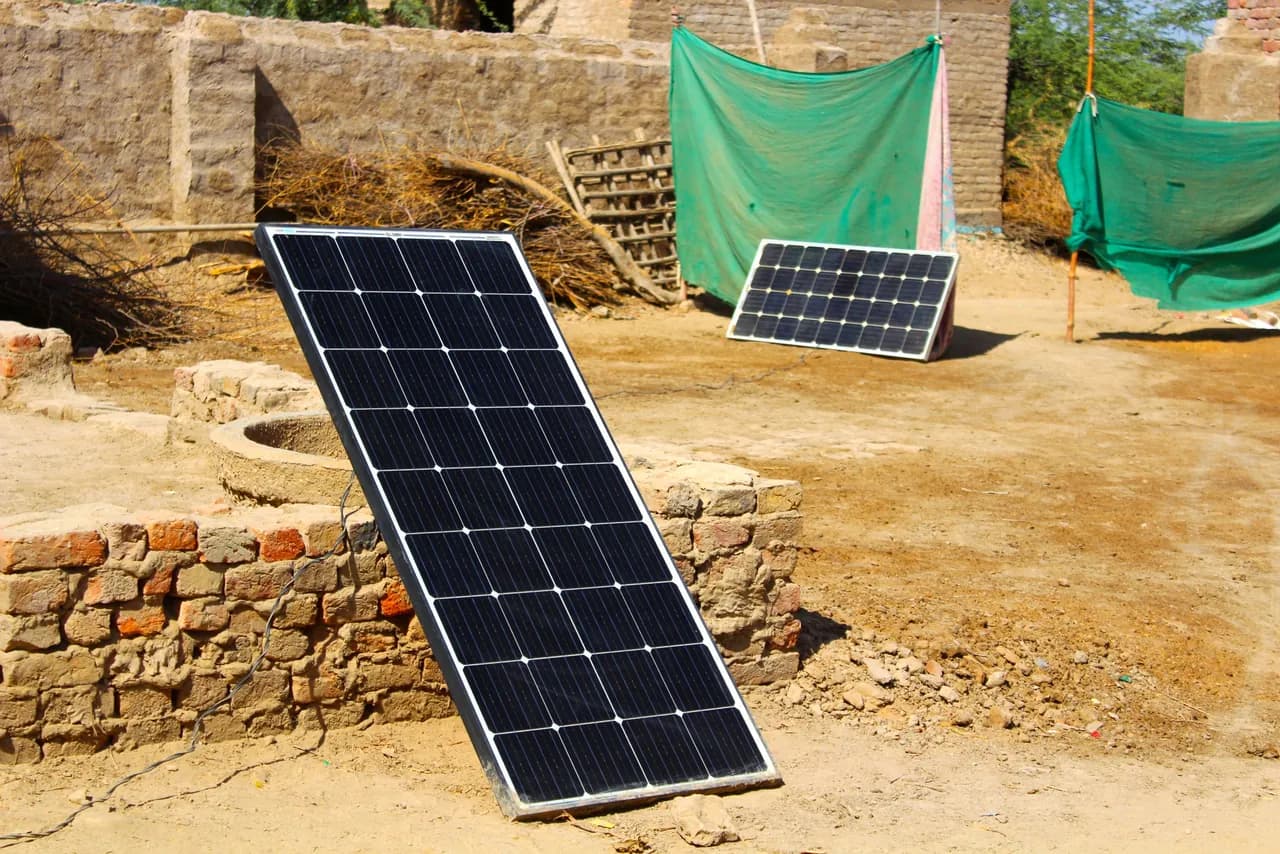
Solar Water Pumping & Irrigation
Water when the sun is up, which is exactly when the crop needs it.
Typical size
Pump ratings from about 1.5 kW to 110 kW, with arrays from roughly 2 kWp to 150 kWp (indicative)
Indicative timeline
Indicative: 1–3 weeks for the hydraulic survey, drawdown test and sizing; 4–10 weeks for supply, installation and commissioning. Where the system is standalone and not exporting to a utility network, no grid approval sits on the critical path.
Solar pumping suits agriculture because the resource and the demand coincide: irradiance peaks when evapotranspiration peaks. CoHub supplies the array, the solar pump drive or dedicated pump inverter, the pump set, the protection and the mounting, and manages the installation through licensed partners. Systems are specified around the well and the reservoir rather than around a catalogue, because the numbers that matter are dynamic head, drawdown and daily cubic metres, not the kilowatt rating on a nameplate.
Who it is for
- Farms and plantations across Al Ain, the Northern Emirates and the western region relying on well or reservoir irrigation
- Livestock and camel stations needing a reliable daily volume for drinking troughs and washdown
- Landscaping, nursery and municipal green-space operators pumping from tanks or treated-water lines
- Remote estates and desert holdings where a pump currently runs on a small diesel engine
What the package covers
- Hydraulic survey: static and dynamic head, drawdown test, pipe sizing, friction losses and required daily volume
- Well and water-quality review including sand content, salinity and the resulting pump and material selection
- Array sizing and yield simulation against a daily-volume target across the irrigation season, not an annual average
- Electrical design, protection and earthing, and the control philosophy issued by a licensed consultant where required
- Supply of modules, pump inverter or solar drive, submersible or surface pump set, cabling, protection and mounting
- Freight, marine insurance, UAE customs clearance and delivery to the holding with farm-access planning
- Installation, pump setting, cabling and earthing by licensed contracting partners, with commissioning and flow verification
- Operator handover, seasonal cleaning and maintenance schedule and a spare-parts kit including a spare drive where remote
What you end up holding
- Hydraulic and sizing report stating head, drawdown, pipe losses and the modelled daily cubic metres by month (indicative)
- As-built electrical diagram, protection schedule, earthing detail and pump-setting depth record
- Commissioning and flow-test record measured at the discharge, with dry-run and over-pressure protection verified
- Operation manual in plain language for the farm team, plus a seasonal maintenance and cleaning schedule
- Consolidated warranty pack for modules, drive and pump set, and the spare-parts register
Indicative parameters
Typical values for a UAE site. Your figures come from the survey and the yield simulation.
- Drive type
- Dedicated solar pump inverter with MPPT, or a standard VFD with solar input where the duty suits (typical)
- Pump type
- Submersible multistage for wells, surface centrifugal for tanks and canals; stainless wet end for saline water
- Array-to-pump ratio
- Array typically sized 1.3–1.5 times the pump kW to widen the daily pumping window (indicative)
- Protection
- Dry-run and low-water cut-out, over and under voltage, over-current, over-pressure and reverse-rotation protection
- Storage strategy
- Store water in an elevated tank or reservoir rather than in batteries wherever the site allows it
- Environmental rating
- IP65/IP66 drive enclosure, shaded and ventilated; C4 or C5-M protection by distance from the coast
- Mounting
- Ground-mount on screw piles or ballast, raised and fenced against livestock and vehicle damage
Typical values for a UAE site. Your figures come from the survey and the yield simulation.
The resource matches the demand
Solar pumping is one of the few applications where the energy source and the load are naturally in phase. Irrigation demand rises with heat and sunshine because evapotranspiration does, so the hours of strongest irradiance are the hours the crop most needs water. That coincidence removes the usual objection to solar, which is that generation and consumption do not align, and it means water can be stored instead of electricity. An elevated tank or a lined reservoir is a far cheaper, longer-lived and simpler buffer than a battery bank, and it also gives the farm gravity pressure for distribution. Where a battery is genuinely needed — for a night-time drinking trough or a booster set — it is added deliberately and sized small, rather than bought by default.
The well decides the system, not the catalogue
The single most common failure in solar pumping is a system sized on the pump nameplate instead of on the hydraulics. What matters is total dynamic head: the static lift from the water level to the discharge, plus the drawdown when the pump is actually running, plus friction losses in the pipe run and fittings, plus any pressure needed at the emitters. A drawdown test tells you how the well behaves under load, and it frequently reveals that the pump must be set deeper or the flow rate reduced to avoid pulling the level down to the intake. Water quality matters just as much: sand content drives wear, and salinity drives material selection for the wet end and the rising main. Get those wrong and no amount of extra array will fix the outcome.
Protecting a pump that nobody is watching
A farm pump typically runs unattended for long periods, so the protection settings are what keep it alive. Dry-run and low-water cut-outs prevent the bearing damage that follows a well running short, over and under voltage protection handles a weak or noisy supply, over-pressure protection guards the delivery line when a valve is closed downstream, and reverse-rotation detection matters after any maintenance that could swap two phases. Modern solar pump drives include most of these, but the settings must be configured to your actual well and pipework rather than left at factory defaults. Where the site is remote, a cellular monitoring module that reports a trip immediately is worth more than an extra kilowatt of array, because a pump that stopped on Sunday and is discovered on Wednesday has already cost a crop.
Northern Emirates and Al Ain, in practice
Most agricultural pumping in the UAE sits outside Dubai, across Al Ain and the Northern Emirates, and the practical picture differs from an urban rooftop project. Many holdings are on a weak radial supply or on no supply at all, which makes a standalone solar pump both cheaper and more reliable than a grid extension. Where a connection exists and the owner wants to offset a wider farm load, the relevant scheme is the distributed solar programme operated by Etihad Water & Electricity in Ajman, Umm Al Quwain, Ras Al Khaimah and Fujairah, or the Abu Dhabi energy-netting framework administered through ADDC or AADC for Al Ain. These programmes have their own metering arrangements, sizing rules and approved-contractor lists, and we confirm the applicable route before design rather than assuming Dubai rules apply everywhere.
What you buy and who installs it
CoHub supplies the complete pumping package: modules, mounting, the solar pump drive, the pump set matched to the measured hydraulics, cabling, protection and monitoring, cleared through UAE customs and delivered to the holding. Installation, electrical connection, earthing and commissioning are carried out by licensed contracting partners under our project management, and commissioning includes a measured flow test at the discharge rather than a verbal confirmation that water came out. You receive a hydraulic and sizing report, an as-built diagram, the commissioning record, a plain-language operating manual for the farm team and a consolidated warranty pack. Where the site is remote we recommend holding a spare drive, because a drive is a one-day replacement and a six-week procurement.
Equipment we source for this
A shortlist, not a fixed specification. Availability in the UAE, warranty cover in this territory and acceptance by your utility are all confirmed per project before anything is quoted — some of these makes are supported here more fully than others, and each brand page says which.
Manufacturer names are used to describe equipment CoHub supplies on UAE projects. CoHub does not claim to be an authorised distributor or agent of any manufacturer listed here.
Questions on this solution
Do we need batteries for a solar pump?
Usually not. Storing water in a tank or reservoir is cheaper, lasts far longer and needs almost no maintenance compared with storing electricity. Batteries make sense only for a specific night-time need such as a drinking trough, a booster pump or a controller supply, and in those cases we size them for that duty alone rather than for the whole pumping load.
Can a solar drive run our existing pump?
Often yes, if the motor is a standard three-phase induction type in good condition and the hydraulics still suit the duty. We check insulation resistance, motor rating, cable size and the actual head before recommending it, because reusing a worn pump to save capital cost usually ends with a second mobilisation. Where the existing set is near end of life, replacing it at the same time is the cheaper decision over five years.
What happens on a cloudy day?
Output falls with irradiance and the drive reduces speed rather than stopping, so pumping continues at a lower flow. This is exactly why the sizing is done against a daily volume target with the reservoir providing the buffer, and why the array is typically oversized relative to the pump rating. In the UAE the more common disruption is dust on the modules, not cloud, which the cleaning schedule addresses.
Will the panels survive livestock, dust and farm traffic?
If they are installed for a farm rather than for a rooftop. That means raised mounting with clearance for cleaning, a fenced or bollarded perimeter where vehicles and animals move, cabling in conduit rather than clipped along a fence, and a cleaning schedule matched to the dust exposure of the location. These are specification decisions we make at design stage, not additions after the first damaged module.
Start with your last electricity bill
Send it with the site address and we will come back with a sizing, a bill of materials and a survey date.
Request a quotation