
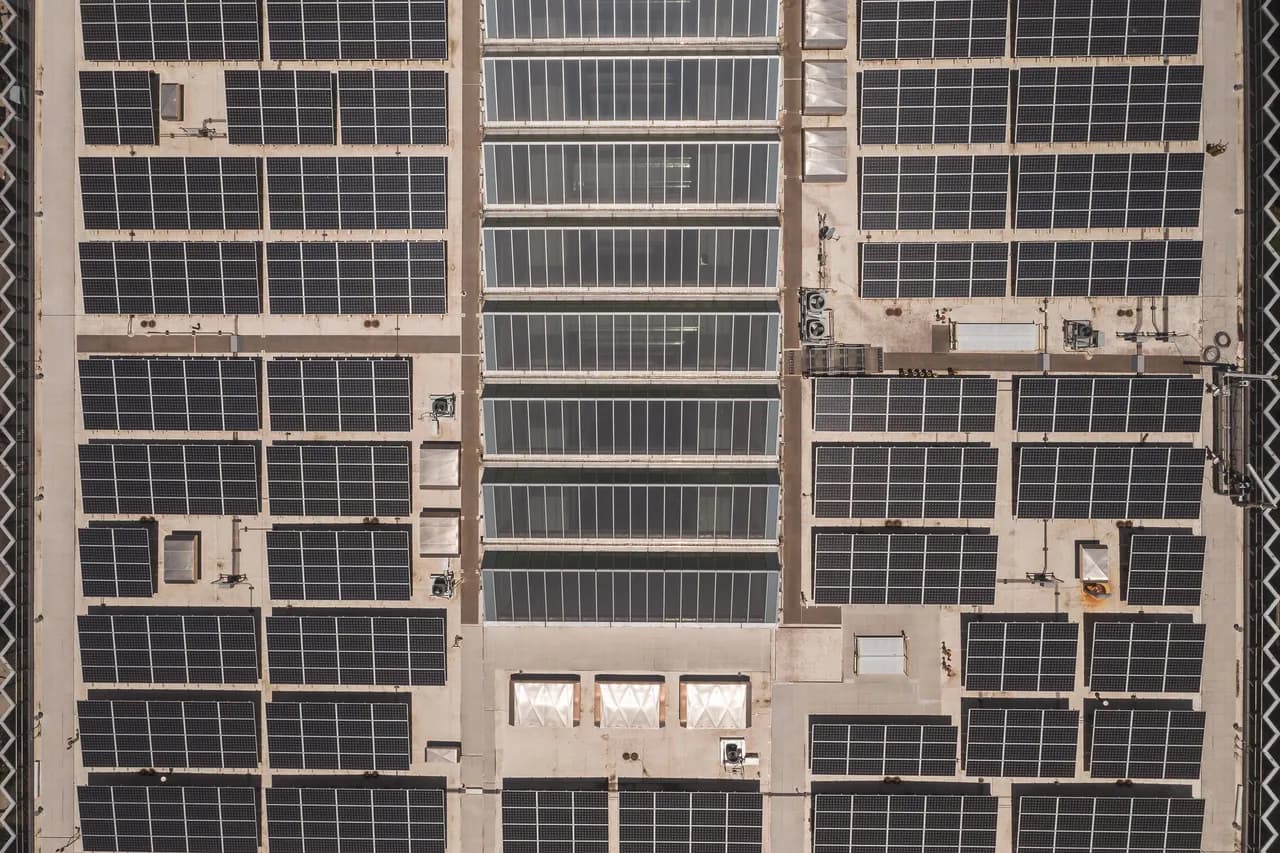
Commercial & Industrial Rooftop Solar
Turn an idle warehouse roof into two decades of generation you already own.
Typical size
Typically 100 kWp to 3 MWp per building; larger estates phased roof by roof (indicative)
Indicative timeline
Indicative: 3–5 weeks for survey, design and utility submission; 4–10 weeks for supply and installation depending on size; energisation follows utility inspection and approval, which is outside CoHub's control and commonly adds several weeks.
Rooftop PV sized against your actual load profile, not against the square metres available. CoHub supplies the modules, inverters, mounting and balance of system, and carries the project as a single supply contract; the design is issued by a licensed consultant and the installation and grid connection are executed by our utility-enrolled contracting partner. The result is a plant that offsets daytime consumption where your tariff is highest, with a documented handover pack you can hand to a lender, an insurer or a landlord.
Who it is for
- Logistics and distribution warehouses with large single-storey roofs and a daytime chiller or forklift-charging load
- Light and medium manufacturing plants running compressors, extruders or process cooling on a weekday shift pattern
- Retail centres, showrooms and hospitality buildings where HVAC demand peaks with solar noon
- Schools, campuses, clinics and labour accommodation blocks with predictable, metered consumption
What the package covers
- Site survey, roof condition and structural review, shading study and a measured record of the existing electrical room
- Load-profile analysis from your utility bills and interval data, then yield simulation for the sized array
- Single-line diagram, protection philosophy, earthing and structural layout issued by a licensed consultant on the project
- Bill of materials and supply: modules, inverters, mounting, DC and AC cabling, combiners, protection and monitoring
- Freight, marine insurance and customs clearance into the UAE, with delivery sequenced to the installation programme
- Installation, cabling and terminations by our DEWA-enrolled contracting partner, working to the approved drawings
- Utility application, inspection, witness testing, commissioning and energisation under the applicable net-metering scheme
- Handover documentation, O&M and cleaning contract, spare-part holding for inverters, fuses and connectors
What you end up holding
- Yield and financial report: simulated annual generation, loss waterfall, self-consumption share and payback range (indicative)
- As-built single-line diagram, array layout, string map and cable schedule
- Structural assessment and roof-fixing detail, including waterproofing method statement
- Test and commissioning certificates to IEC 62446-1: insulation resistance, polarity, I-V curve tracing and earth continuity
- Utility approval file: application, NOC, connection agreement and net-metering activation record
- O&M manual, monitoring portal credentials and the consolidated manufacturer warranty pack
Indicative parameters
Typical values for a UAE site. Your figures come from the survey and the yield simulation.
- Indicative specific yield
- 1,600–1,900 kWh/kWp/year, tilt and soiling dependent (indicative)
- Typical performance ratio
- 78–82% once thermal and soiling losses are modelled (typical, not guaranteed)
- System voltage architecture
- 1100 V DC on most commercial roofs; 1500 V DC where string lengths and the electrical room allow
- DC:AC ratio
- 1.15–1.30 typical, set by the load curve and the export limit agreed with the utility
- Module temperature coefficient
- About −0.29 to −0.34 %/°C for current n-type and PERC modules (manufacturer dependent)
- Ingress and corrosion class
- IP65/IP66 enclosures; C4 inland, C5-M specified within a few kilometres of the coast
- Cleaning cycle
- Typically every 2–6 weeks depending on dust exposure and post-sandstorm events (indicative)
Typical values for a UAE site. Your figures come from the survey and the yield simulation.
A Gulf roof is not a European roof
A module is rated at 25°C cell temperature, and a UAE roof never offers that. With summer ambient above 50°C and module temperatures commonly reaching 75–80°C, a temperature coefficient of roughly −0.29 to −0.34 %/°C quietly removes real output in exactly the hours your chillers are working hardest. The engineering answer is not a larger array but a better one: mounting raised enough for air to pass under the frames, string lengths checked against the coldest morning rather than the hottest afternoon, and inverters chosen with thermal headroom at 50°C instead of at nameplate conditions. Indicative specific yield for a well-designed flat-roof system in the UAE sits in the 1,600–1,900 kWh/kWp per year band, with a typical performance ratio of 78–82% once thermal and soiling losses are modelled honestly rather than optimistically.
The roof is a structure before it is a power plant
Most warehouse roofs in the UAE were never designed to carry a permanent array, and the honest first question is what the purlins and sheeting will actually take. A licensed consultant on the project reviews the original structural drawings, confirms the residual capacity, and decides between a ballasted system, a clamped connection onto standing-seam sheeting, or a penetrating fixing with a properly detailed flashing. Wind is the governing load case, not snow: the UAE is outside the cyclone belt, but summer shamal events and localised gusts drive uplift on the array edges and corners, which is why module clamping zones and rail spans are set by calculation. Where a fixing has to penetrate an existing membrane, the waterproofing method statement matters as much as the electrical design, because a leaking roof will cost more than the solar ever saved.
Size against the load curve, not the square metres
The most expensive mistake in commercial rooftop solar is filling the roof. Under DEWA's Shams Dubai scheme the exported surplus is credited in kilowatt-hours against future consumption rather than paid in cash, and the permitted system size is bounded by the slab your plot's total connected load falls into, so an oversized array buys credits you may never consume. The useful design target is high self-consumption: match generation to the weekday daytime curve, look at what happens on Fridays and shutdown weeks, and only then decide whether storage or an export-limited design is the better answer. In the Northern Emirates the EtihadWE distributed solar scheme and in Abu Dhabi the small-scale energy-netting regulation each have their own metering and sizing rules, and the design is built around whichever one applies to your meter.
One counterparty, licensed specialists on site
CoHub carries the supply contract and manages delivery end to end: the bill of materials, the freight and customs clearance, the programme, the interfaces and the handover file are ours. The licensed work sits where the law puts it. A consultant enrolled with the relevant utility issues and stamps the design, our DEWA-enrolled contracting partner installs, tests and applies for the connection, and the utility inspects and energises. You sign one supply agreement and talk to one project manager, while the people touching live conductors and utility paperwork are the people licensed to do it. That structure also makes the commercial side cleaner: a single bill of materials means a single equipment warranty pack, a single spare-parts list, and no argument about whether a fault is a supply problem or an installation problem.
Soiling, monitoring and what the plant is worth in year ten
Dust is the single largest controllable loss in this climate. Published desert-climate studies report soiling losses climbing steeply over a few uncleaned weeks, which is why a cleaning cycle of roughly every two to six weeks, plus an unscheduled clean after a significant sandstorm, is written into the O&M contract rather than left to goodwill. Monitoring earns its place here: string-level or module-level data turns a vague underperformance into a named string, and a portal that reports performance ratio per month tells you whether the plant is dirty, shaded or genuinely faulty. Over the long term the items that decide residual value are unglamorous — PID-resistant modules, DC isolation and arc-fault detection that actually trip, connectors of one make correctly crimped, and inverter spares held locally so a failed unit is a week of downtime, not a quarter.
Equipment we source for this
A shortlist, not a fixed specification. Availability in the UAE, warranty cover in this territory and acceptance by your utility are all confirmed per project before anything is quoted — some of these makes are supported here more fully than others, and each brand page says which.
Manufacturer names are used to describe equipment CoHub supplies on UAE projects. CoHub does not claim to be an authorised distributor or agent of any manufacturer listed here.
Questions on this solution
Is CoHub a DEWA-registered solar contractor?
No, and we are precise about this. CoHub holds a UAE General Trading licence: we supply the equipment and deliver the project as your single commercial counterparty. The stamped design is issued by a licensed consultant appointed on the project, and installation, testing and the grid-connection application are carried out by our DEWA-enrolled contracting partner. You get one contract and one project manager; the licensed work is done by licensed people.
How much of my electricity bill can rooftop solar realistically cover?
It depends on roof area, load shape and the permitted system size, not on a marketing percentage. A warehouse with a strong weekday daytime load and an unobstructed roof can often offset a substantial share of daytime consumption, while a 24-hour operation will offset a smaller proportion without storage. We answer this properly only after reading twelve months of bills and, where available, interval data. Every figure we quote before that is an indicative modelled range.
My roof is old. Does that rule solar out?
Not automatically, but it changes the sequence. The structural review and roof condition survey come first, and if the sheeting or waterproofing is near the end of its life the sensible order is to renew the roof and then install, because nobody wants to demount an array in year three. Where residual structural capacity is limited, lighter mounting, reduced ballast or a partial-coverage layout are all legitimate design responses.
Do I own the system, or is this a lease?
CoHub supplies and delivers systems that you own outright from handover. There is no power purchase agreement, no lease on your roof and no third party holding a claim over your generation. The full warranty pack is issued in your name, and the O&M contract is a separate, cancellable service agreement rather than a condition of ownership.
What happens if a module or inverter fails in year four?
You hold a consolidated warranty pack naming each manufacturer, the term and the claim route, and we hold the serial-number register from commissioning, so a claim starts with evidence rather than a search. For inverters we recommend holding a spare unit or a service agreement with defined response times, because in practice the delay in a warranty claim is logistics, not liability.
Start with your last electricity bill
Send it with the site address and we will come back with a sizing, a bill of materials and a survey date.
Request a quotation