
Utility-Scale & Ground-Mount Solar Farms
Megawatt-class supply packages and managed execution, from pile design to the MV interface.
Typical size
From 1 MWp to 100 MWp and above, delivered in phases or as a single supply package (indicative)
Indicative timeline
Indicative: 6–12 weeks for land assessment, geotechnical work, design and utility or authority submission; 4–9 months for supply, civil works and installation depending on megawatt size and shipping windows. Energisation follows utility approval and grid-code testing, which sit outside CoHub's control.
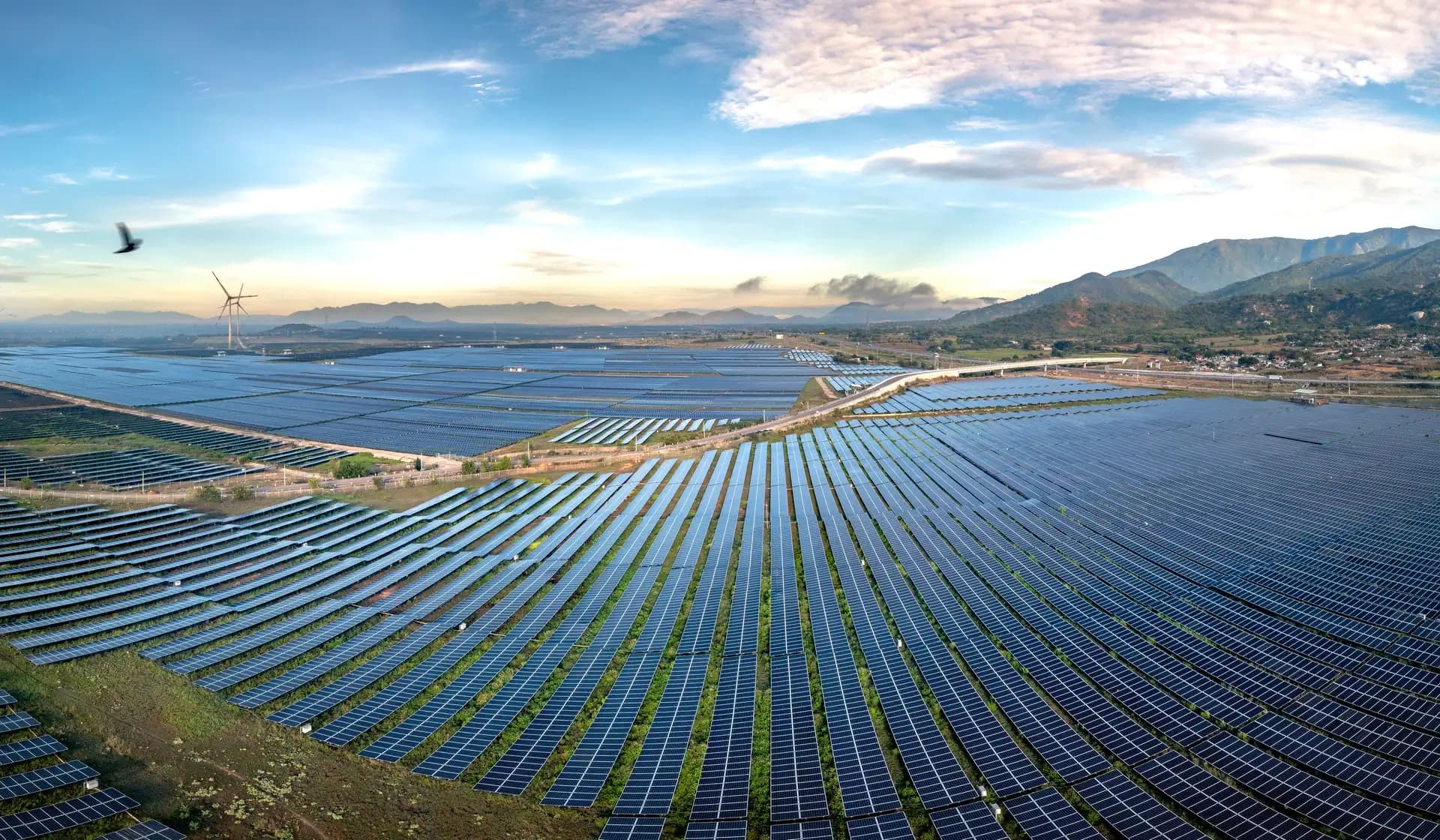
Ground-mounted plants for industrial estates, free-zone land, mining and quarry operations, agricultural holdings and private generation behind a large meter. CoHub assembles and supplies the full bill of materials — modules, central or string inverters, fixed-tilt or tracker structures, DC and MV cabling, transformers, SCADA — clears it into the UAE, and manages the programme against the milestone dates. Geotechnical work, stamped design, civil and electrical construction and the grid interface are executed by licensed contracting and consultancy partners under our project management.
Who it is for
- Industrial estates and free-zone occupiers with spare land adjacent to a large connected load
- Quarrying, cement, mining and heavy-process operators looking to displace grid or diesel generation at scale
- Agricultural and desert land holdings where irrigation, cold storage and packing houses form a large steady load
- Developers and IPP-track sponsors needing an equipment supply partner with three-continent sourcing
What the package covers
- Land screening, topographic and shading assessment, irradiance data sourcing and a bankable yield simulation
- Geotechnical investigation and pull-out testing to fix the pile or foundation type, arranged with a specialist partner
- Plant layout, string sizing, DC and MV single-line diagrams and protection studies issued by a licensed consultant
- Bill of materials and supply: modules, inverters, trackers or fixed structures, cabling, combiners, transformers, SCADA
- Container-level logistics planning, marine insurance, UAE customs clearance and sequenced site deliveries with laydown planning
- Civil works, structure erection, module installation and cabling by licensed contracting partners under CoHub programme management
- Testing, energisation, grid-code compliance testing and the LV/MV interface with the utility or the private network
- Performance-test handover, long-term O&M and cleaning contracts, and a strategic spare-parts holding on site
What you end up holding
- Bankable energy-yield report with P50 and P90 estimates, loss waterfall and degradation assumptions stated
- Geotechnical report and foundation design basis, including pull-out test results and corrosion assessment of the soil
- Full design set: plant layout, DC and MV single-line diagrams, earthing and lightning-protection design, cable schedules
- Commissioning and performance-test dossier: IEC 62446 tests, I-V curve traces, thermographic survey and capacity test results
- Grid connection and compliance file: utility correspondence, protection settings and grid-code test records
- O&M manual, SCADA handover, spare-parts register and the consolidated manufacturer warranty pack
Indicative parameters
Typical values for a UAE site. Your figures come from the survey and the yield simulation.
- System architecture
- 1500 V DC standard at this scale, central or distributed string inverters by layout (typical)
- Mounting
- Fixed-tilt at roughly 10–25° or single-axis horizontal trackers, chosen on land cost and O&M access (indicative)
- Bifacial gain
- Typically 4–12% over monofacial depending on ground albedo, mounting height and row pitch (indicative)
- Indicative specific yield
- 1,700–1,900 kWh/kWp/year for a well-sited UAE ground-mount plant (indicative, site dependent)
- MV interface
- 11 kV or 33 kV via skid or containerised step-up transformer with RMU and protection relays (typical)
- Design environment
- Ambient above 50°C, sandstorm-prone rather than cyclone-prone; wind loading to the applicable local code
- Monitoring
- SCADA with weather station, string-level current monitoring and PR reporting at plant and block level
Typical values for a UAE site. Your figures come from the survey and the yield simulation.
Ground is a different discipline from roof
At megawatt scale the plant is decided in the ground before it is decided in the electrical room. A geotechnical investigation with pull-out testing establishes whether driven piles hold in the local sabkha, sand or cemented layers, or whether screw piles or concrete ballast are required, and the soil chemistry sets the galvanising thickness or the case for pre-galvanised versus hot-dip steel. Row pitch is then a commercial decision as much as a technical one: tighter rows buy capacity per hectare and pay for it in winter shading losses, wider rows raise bifacial gain and cleaning access but consume land. Tracker versus fixed-tilt is settled the same way, on land cost, terrain, O&M capability and the value of the shoulder-hour generation a single-axis tracker adds.
Where a large plant is allowed to connect
It is worth being clear about the regulatory map before anyone draws a layout. DEWA's Shams Dubai scheme is written for distributed generation on rooftops, facades and existing structures, and its published guidelines do not envisage ground-mounted installations, so a large ground-mount inside Dubai is not simply a bigger net-metering application. Very large plants in the UAE are typically procured through utility and offtaker tender routes rather than through a distribution-network connection. What is genuinely open to a private owner is behind-the-meter generation on their own land against their own large load, or a private-wire arrangement inside an industrial estate, each with its own approval path through the relevant authority. We establish which route applies at the feasibility stage, because it changes the design, the timeline and the financial model entirely.
Bifacial, albedo and the honest version of the gain
Bifacial modules are the default at this scale and the marketing numbers around them deserve scepticism. Rear-side gain is a function of ground albedo, mounting height, row pitch and how much of the rear face the structure itself shades, so a plant on pale desert sand with generous clearance behaves very differently from one on dark compacted gravel with low tables. A typical modelled gain sits in the 4–12% range for UAE conditions, and it should be simulated with the actual albedo measured or credibly assumed for the site rather than lifted from a datasheet. The same discipline applies to the loss side: soiling, mismatch, thermal derating, DC and AC cable losses, transformer losses and availability all belong in the waterfall, and a yield report without a visible waterfall is a brochure, not an engineering document.
Supply at container scale, cleared into the UAE
At this size the procurement is the project risk. CoHub carries the supply contract across all three sourcing continents, consolidates the bill of materials so the modules, inverters, structures and balance of system arrive as one coordinated programme, and handles freight, marine insurance and UAE customs clearance so the site is not idle waiting for a release. Equipment is specified to what can actually be imported and installed here: PV modules certified to IEC 61215 and IEC 61730, inverters to IEC 62109, and conformity under the MoIAT scheme that governs renewable-energy products entering the UAE market. Delivery is sequenced to the erection programme with laydown and crane planning agreed in advance, because on a megawatt site a container in the wrong week is a fortnight of lost productivity.
Who builds it, and who is accountable for it
CoHub is the single commercial counterparty: one supply contract, one programme, one project manager, one handover file. The licensed scope sits with licensed firms. A consultant appointed on the project issues and stamps the design and the protection studies, licensed civil and electrical contracting partners execute the works, and the grid interface, compliance testing and energisation are handled by the enrolled contractor with the utility. That division is not a limitation, it is how large projects are meant to be delivered in the UAE, and it means the party procuring your equipment has no incentive to specify around an installation shortcut. On handover you receive a performance-test dossier, a SCADA system you control, a spare-parts register and an O&M contract with defined response times and cleaning cycles.
Equipment we source for this
A shortlist, not a fixed specification. Availability in the UAE, warranty cover in this territory and acceptance by your utility are all confirmed per project before anything is quoted — some of these makes are supported here more fully than others, and each brand page says which.
Manufacturer names are used to describe equipment CoHub supplies on UAE projects. CoHub does not claim to be an authorised distributor or agent of any manufacturer listed here.
Questions on this solution
Can I build a ground-mounted solar farm on my land in Dubai?
It depends entirely on the connection route. The published Shams Dubai guidelines are written for rooftops, facades and existing structures and do not envisage ground-mounted installations, so a ground-mount is not a standard net-metering application. What is usually viable is behind-the-meter generation serving your own large load, or a private arrangement within an industrial estate. We confirm the applicable route with the relevant authority during feasibility before any design work begins.
Tracker or fixed-tilt for a UAE site?
Single-axis trackers typically add meaningful annual yield by capturing morning and evening hours, at the cost of moving parts, higher capital expenditure and an O&M regime that must actually be resourced. Fixed-tilt is simpler, cheaper to maintain and more forgiving in a dusty environment. The decision follows land cost, the shape of the load you are serving and whether the site will have a competent maintenance team. We model both with your site data rather than defaulting to one.
How is water for cleaning handled on a desert site?
It is a design input, not an afterthought. Options range from tankered demineralised water with a wet-brush crew to dry-brush robotic cleaning mounted per row, which removes the water logistics but adds capital cost and imposes constraints on module frame and row geometry from day one. On large remote plants dry cleaning frequently wins on total cost. The choice must be made before the structure is ordered, because retrofitting robotic cleaning onto the wrong table geometry is expensive.
Do you supply equipment only, if we already have an EPC?
Yes. A supply-only package is a normal scope for us: bill of materials, three-continent sourcing, consolidated shipping, marine insurance, UAE customs clearance and sequenced delivery to your contractor's programme, with the warranty pack issued in your name. We will still review the design basis against the equipment being specified, because a mismatch between string design and inverter window is easier to catch on paper than on site.
What degradation should we assume in the financial model?
Use the manufacturer's published performance warranty curve for the exact module being supplied, not a generic industry figure, and state the assumption openly in the model. Current premium n-type modules publish lower annual degradation than older technologies, but the number varies by product and the warranty wording matters more than the headline. We supply the actual datasheet and warranty document for every module in the bill of materials so the assumption in your model is traceable.
Start with your last electricity bill
Send it with the site address and we will come back with a sizing, a bill of materials and a survey date.
Request a quotation