
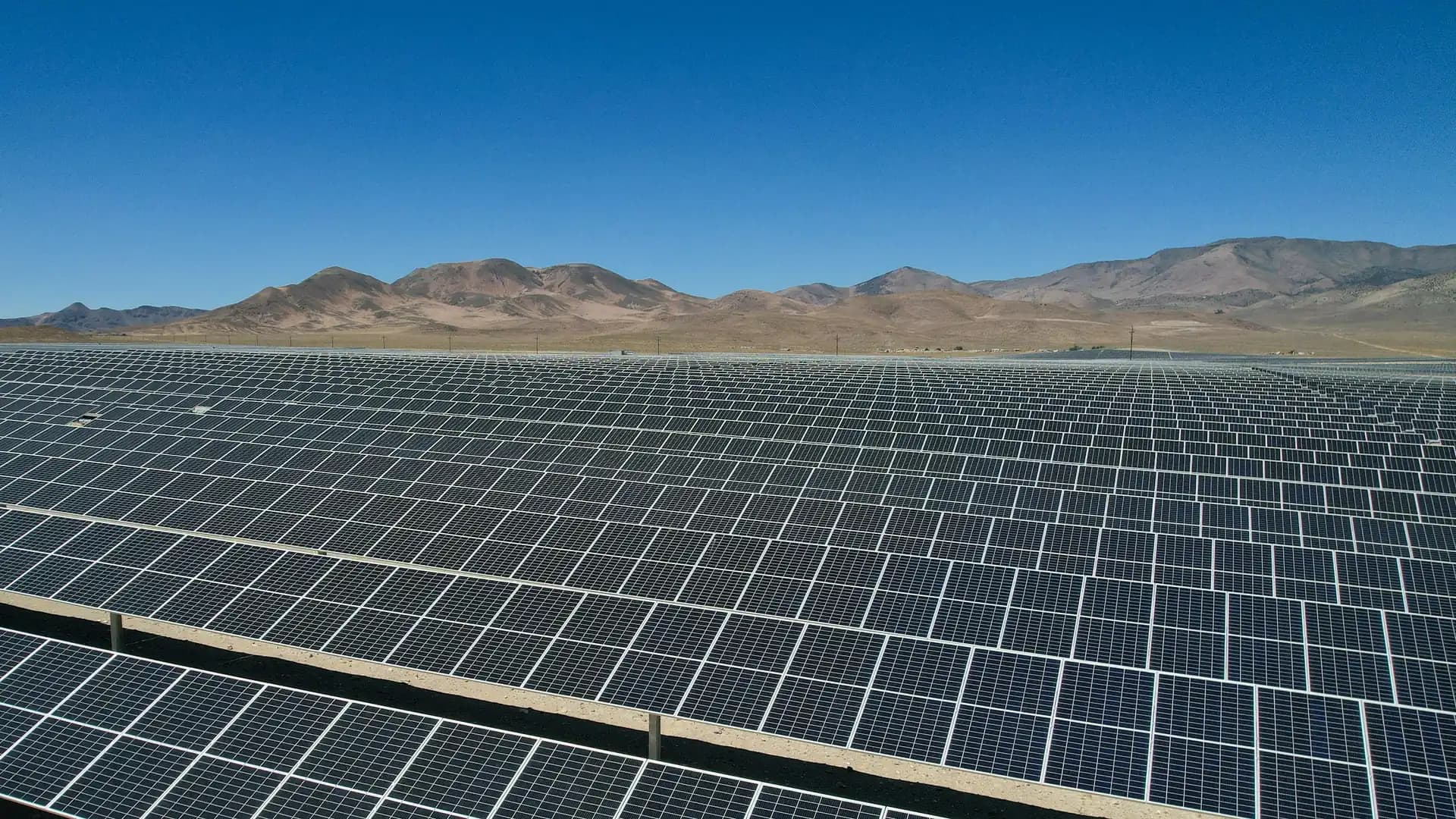
Solar & renewable energy · United Arab Emirates
Solar equipment supplied, and the project delivered, across the UAE
We source modules, inverters, storage and mounting from the strongest Chinese, European and American manufacturers, clear them into the country, and run the project through to energisation with licensed contracting partners on site. One supplier, one contract, one accountable counterparty.
- Supply + installation
- DEWA-enrolled partners
- UAE-wide delivery
- Tax invoice & TRN
- JinkoSolar
- LONGi
- Trina Solar
- JA Solar
- Sungrow
- Huawei FusionSolar
- GoodWe
- BYD Energy Storage
- SMA Solar Technology
- Fronius
- Victron Energy
- K2 Systems
- Stäubli
- Schneider Electric
- Hitachi Energy
- Tesla Energy
- Enphase Energy
- First Solar
- Generac
- Array Technologies
- Ampt
A trading company that also gets the system switched on
CoHub buys the equipment, owns the supply contract and manages delivery end to end. Design, installation, testing and the utility application are performed by licensed, utility-enrolled contracting and consultancy partners working under that contract. You deal with one company commercially, and the licensed specialists who have to sign the work are the ones who sign it.
Why buy the system through CoHub
Multi-brand sourcing across three continents
We are not an agency line with one manufacturer to defend. We specify modules, inverters, storage and mounting from Chinese, European and American makers and put the real trade-off in front of you — price against lead time, warranty terms against regional service presence, efficiency against cost per kWh. If a cheaper brand is genuinely the right answer for your roof, that is what appears in the bill of materials.
One contract, one accountable counterparty
A solar project touches a consultant, a contractor, a freight forwarder, a customs broker and several manufacturers. You sign with CoHub and deal with CoHub: one scope, one programme, one invoice trail, one phone number when a date slips. We carry the interfaces between those parties instead of handing you a list of them, which is the difference between managing a supplier and managing a project.
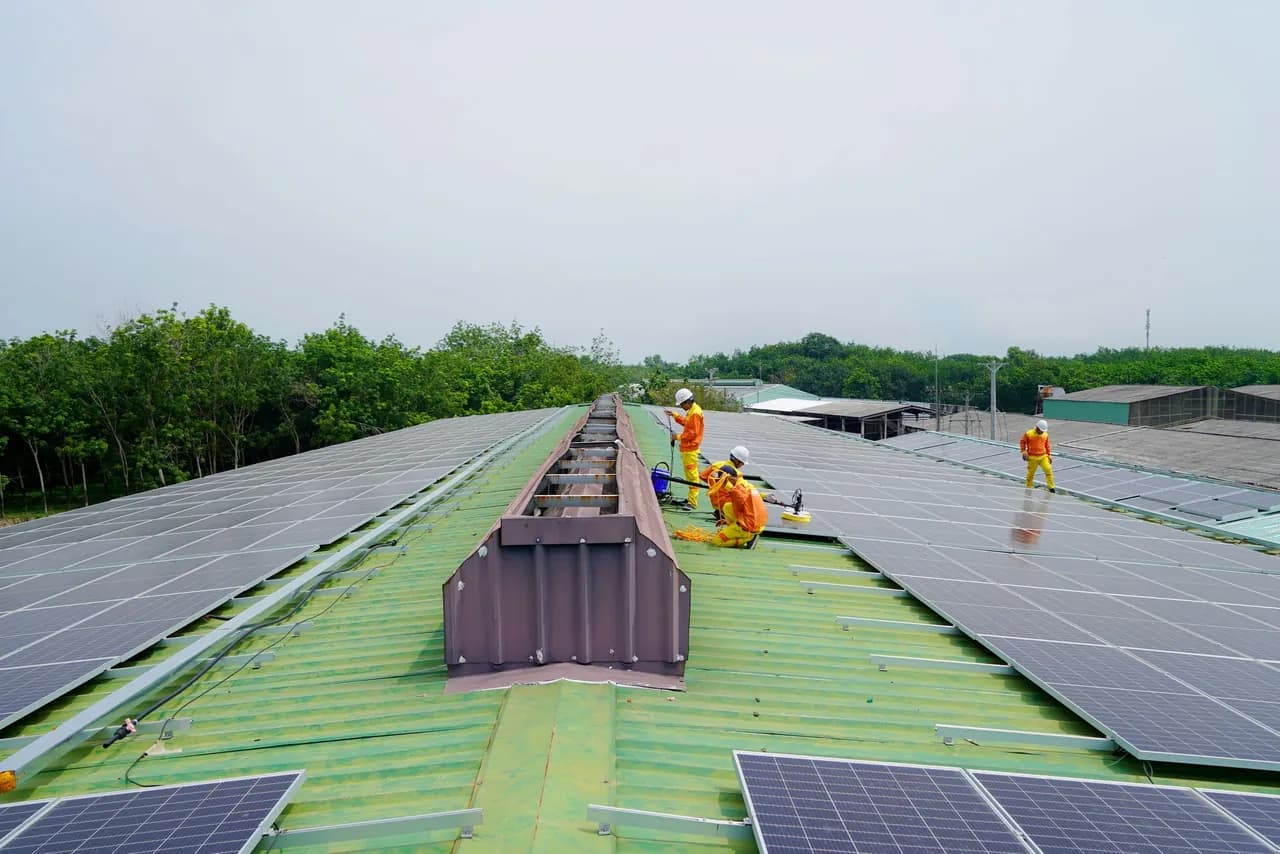
Licensed consultancy and contracting partners on site
The design is produced and stamped by a licensed solar consultant, and the installation, testing and utility application are executed by a licensed contractor enrolled with the relevant utility — DEWA under Shams Dubai, or the approved lists in Abu Dhabi, Sharjah and the Northern Emirates. CoHub engages and manages them. That is how a UAE grid connection is legally obtained, and it means your design carries a specialist's signature rather than a supplier's confidence.
Import, customs and Jebel Ali logistics handled
Bringing a solar bill of materials into the UAE is its own project: production slots, container consolidation, conformity documentation, customs entry, inland transport and staged delivery to a live site. CoHub is the importer of record and carries that work, so the contractor arrives to equipment already on site with its paperwork complete rather than to a shipment stuck in clearance.
Spare parts and RMA continuity after handover
The relationship does not end at energisation, because that is when a twenty-five-year asset starts its life. We keep your serial numbers, commissioning records and purchase documents, we hold or can source critical spares — connectors, fuses, surge protection, inverter fans and filters — and we run warranty claims with the manufacturer on your behalf. Before we specify a brand we check what its claim process actually looks like from the Gulf.
Documentation a UAE finance team can defend
Proforma invoice for approval and budget release, tax invoice issued in CoHub's name with 5% VAT and our TRN in the format the Federal Tax Authority requires, customs and shipping file, serial-number list, conformity certificates and the manufacturers' original warranty documents. Cash on delivery is available under our standard business terms. Everything is in one pack, in your name, ready for an audit — because a project your finance team cannot evidence is a project they will not sign off.
The numbers that shape a UAE system
1,700 kWh/kWp
Indicative annual yield per kWp installed in the UAE
Indicative. Published assessments put a well-oriented, regularly cleaned UAE rooftop array at roughly 1,600–1,900 kWh per kWp per year — around 40% above central Europe. The figure that goes into your proposal comes from a site-specific simulation, not from this page.
8,000 MW
Planned capacity of the Mohammed bin Rashid Al Maktoum Solar Park by 2030
DEWA announced in November 2025 that the park's 2030 target rises to more than 8,000 MW — a 60% increase on the original 5,000 MW plan — against 3,860 MW installed at the time of the announcement. It remains the largest single-site solar park in the world.
100%
Dubai's target share of clean energy in production capacity by 2050
Dubai Clean Energy Strategy 2050 together with the Dubai Net Zero Carbon Emissions Strategy 2050, as restated by DEWA in November 2025, which also lifted the 2030 milestone from 25% to 36%. This is a published government target, not a forecast by CoHub.
~7%
Output lost to dust after a month without cleaning
Indicative. UAE field work in Al Ain measured about 7% power loss after 30 days of dust accumulation with no major sandstorm; GCC-wide reviews report monthly soiling losses reaching roughly 10%. The real number is site-specific, which is exactly why the cleaning interval is an engineering decision and not a housekeeping one.
Industry and regulator figures, not CoHub performance claims. Yield and loss figures are indicative and vary by site.
What we supply and deliver
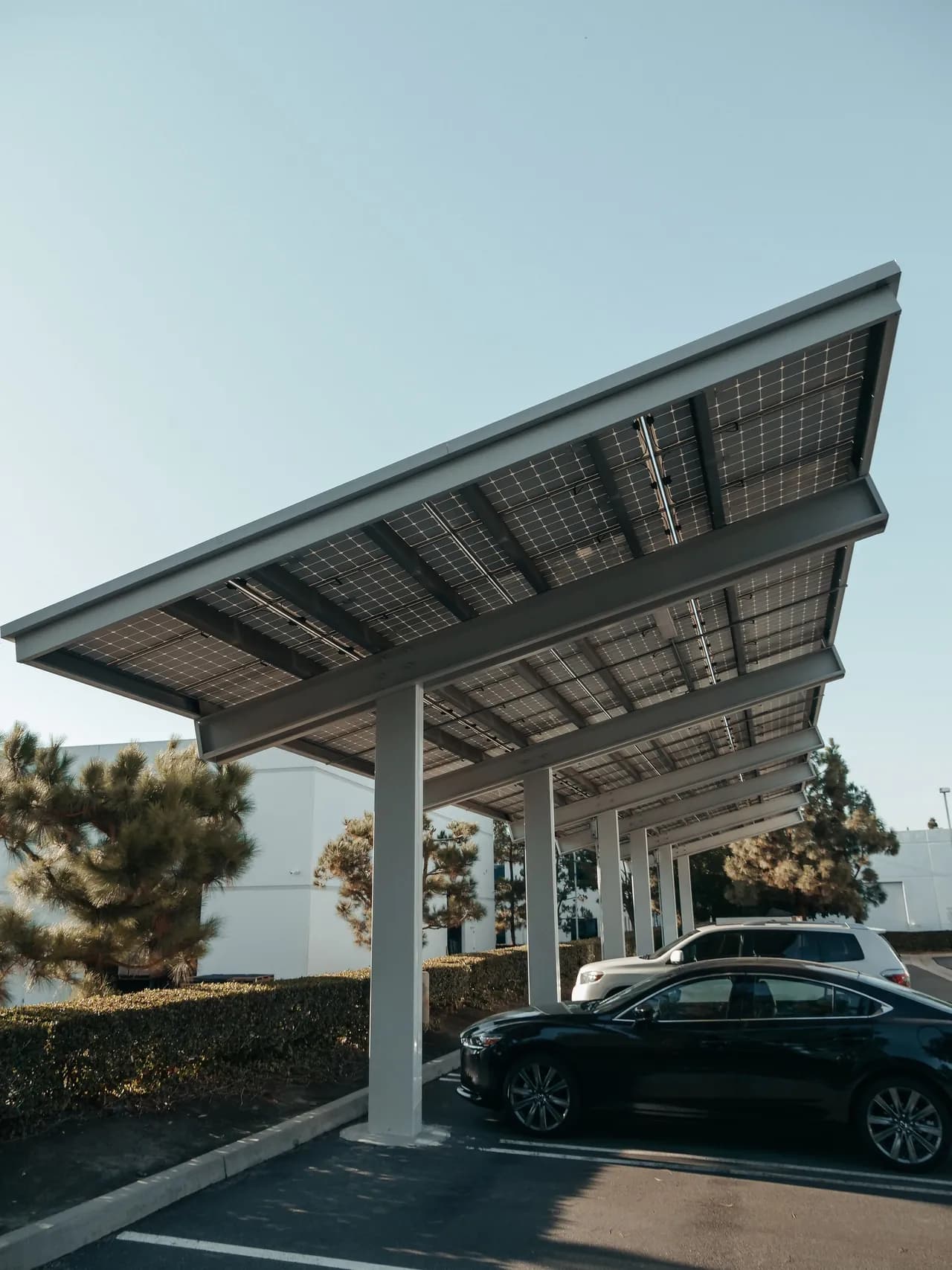
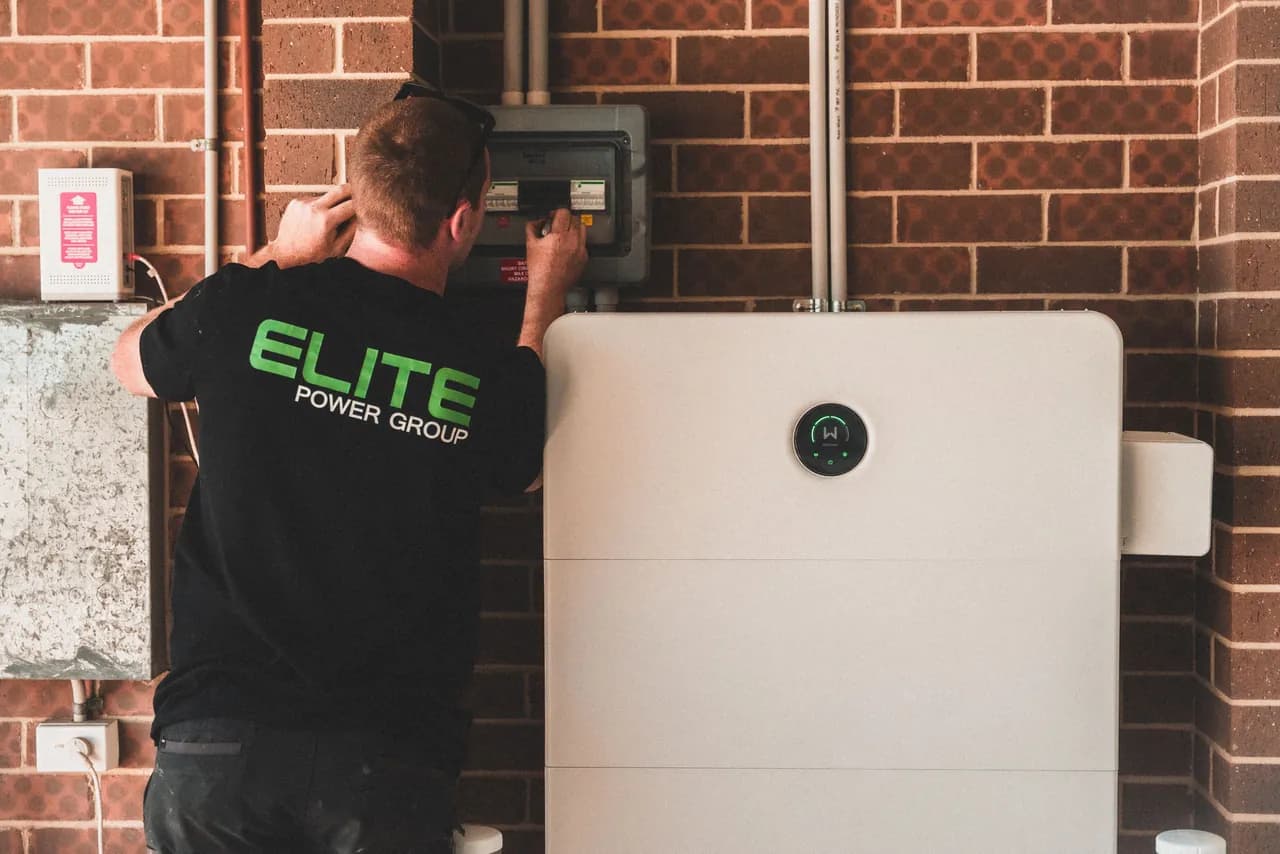
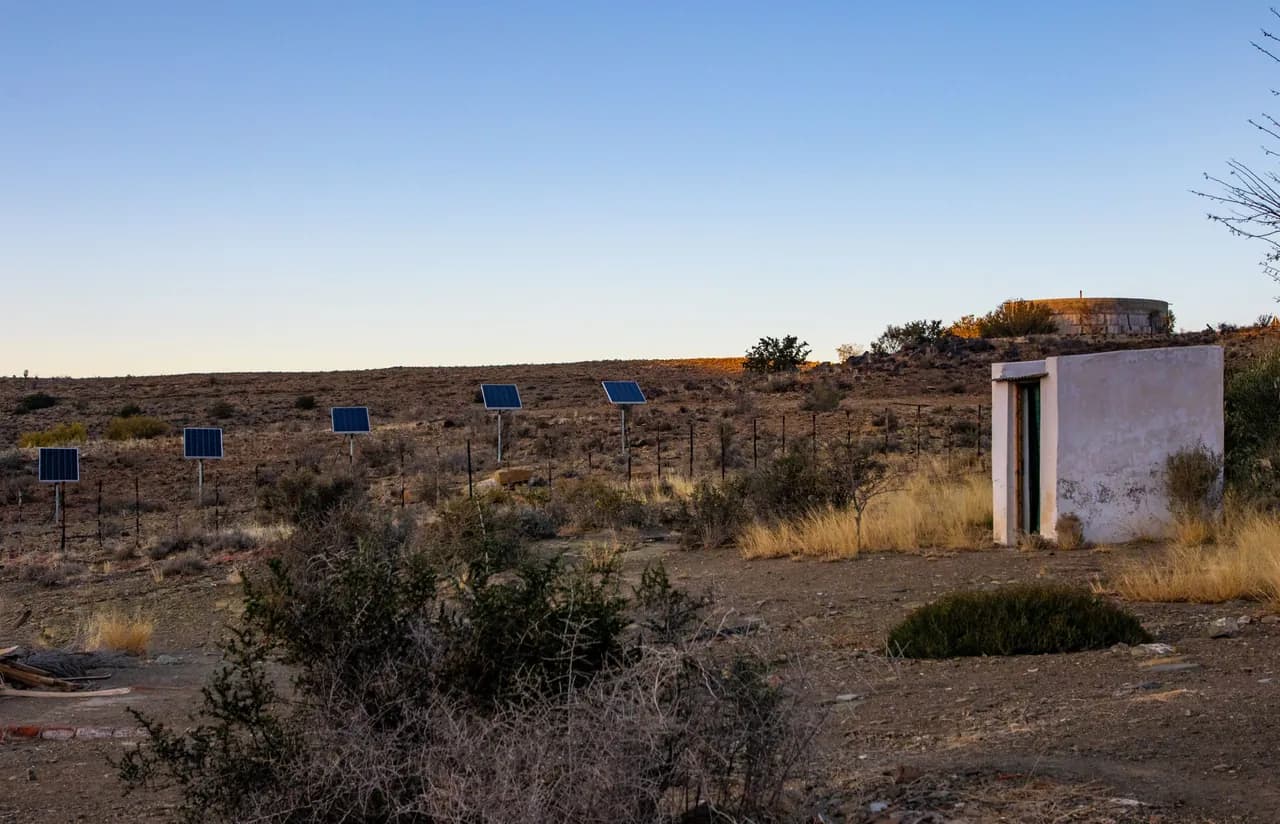
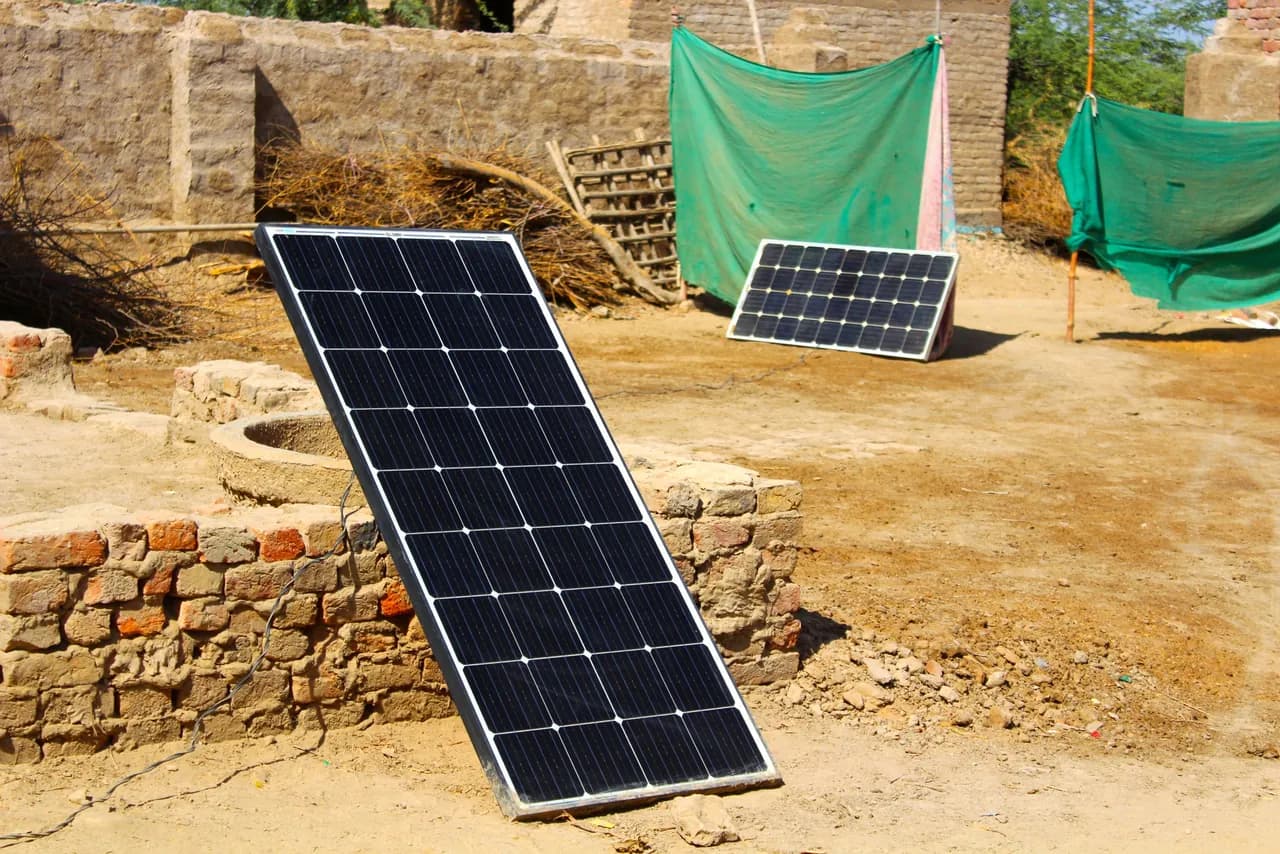
Eight delivery models, each with its own bill of materials, approval route and commissioning sequence. Pick the one that matches your site and we will quote it against a survey.
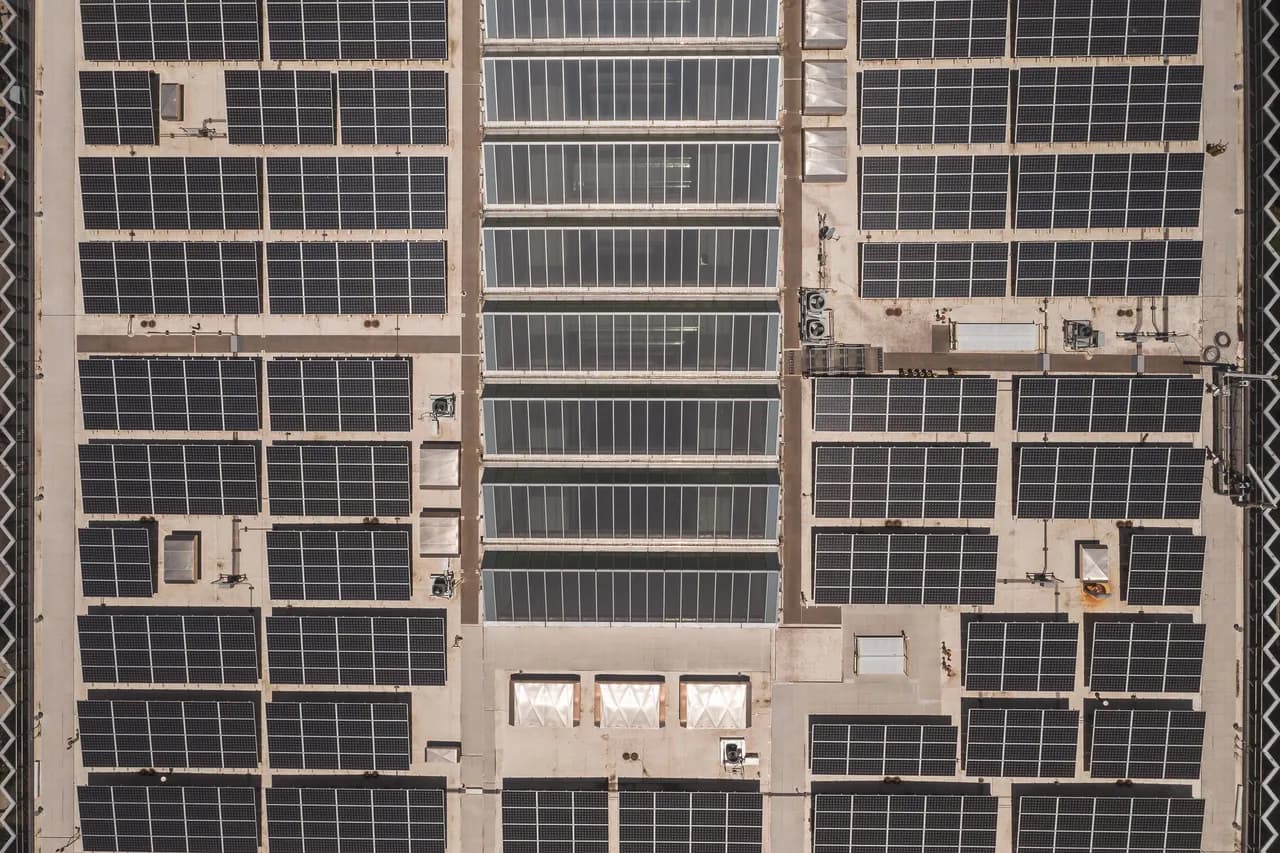
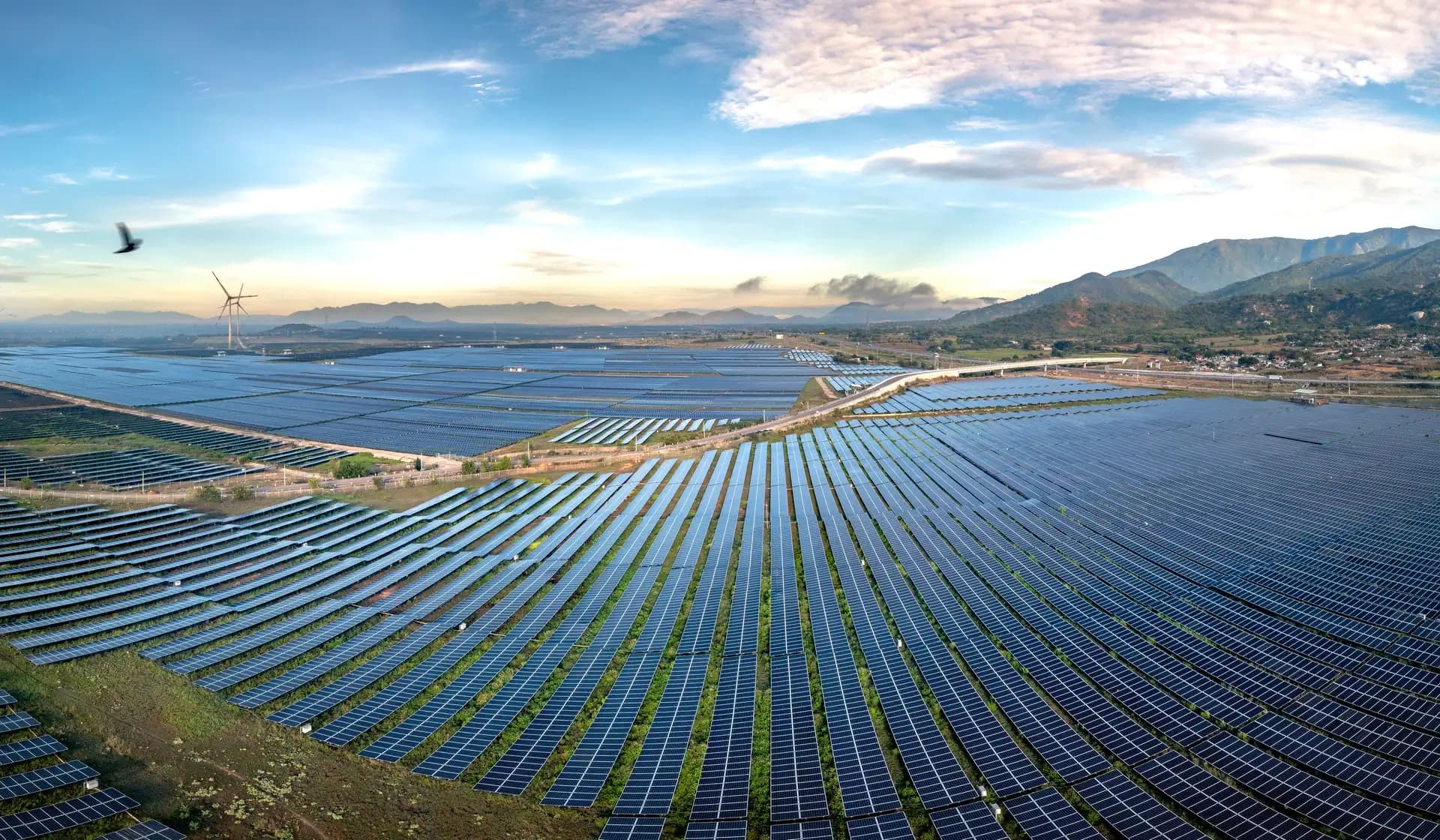
How the energy actually moves
A grid-tied system with optional storage, drawn as a single line. Your own single-line diagram is issued by the consultant on the project and will differ in protection, metering and switchgear detail.
Indicative sizing
Size the system from your electricity bill
Move the four inputs to match your site. Everything on the right is derived from them — no prices, because a solar price without a survey is a guess.
The average across a full year, not a summer peak.
Total bill divided by kWh consumed, including fuel and other surcharges. Check a recent bill.
Roof area, budget and the utility's rules usually cap this well below 100%.
Indicative UAE range is roughly 1,600–1,900 kWh per kWp per year, before soiling and shading losses.
Indicative outcome
System size
272.7kWp
Annual generation
477,273kWh
Modules (580 W)
471pcs
Roof area needed
1,636m²
Annual bill reduction
210,000AED
CO₂ avoided
190.9t/year
Indicative only, derived from your inputs at 6 m² per kWp, 580 W modules and 0.4 kg CO₂ per kWh. It is not a quotation, a guarantee of yield or a commitment to any price. A real proposal follows a site survey, a shading study and your utility's rules.
Send these numbers to the deskEngineered for Gulf conditions
Heat, dust and salt decide which equipment survives here. These are the six constraints that change a specification written for Europe into one that works on a Dubai roof.
45–50 °C ambient, and what heat takes off the nameplate
The condition
Module power is rated at a 25 °C cell temperature. On a UAE summer roof the cell sits far above ambient — commonly 70 °C and beyond — and with a Pmax temperature coefficient of roughly −0.29 to −0.35 %/°C on modern n-type and PERC modules, that is a double-digit percentage off the nameplate at exactly the hour your chillers peak. Inverters have their own derating curve and start throttling output above their rated ambient.
What we specify
Specify modules with a low temperature coefficient and check the NOCT figure, not just the STC watts. Size the DC:AC ratio on hot-hour output rather than on a European rule of thumb, and read the inverter's derating curve at 50 °C before accepting its rated kW. Mount inverters shaded and ventilated — north-facing wall, not under the array in still air — raise the array off the roof surface for airflow, and model the temperature loss explicitly in the yield simulation instead of hiding it in a generic performance ratio.
Dust, soiling and a cleaning regime that is part of the design
The condition
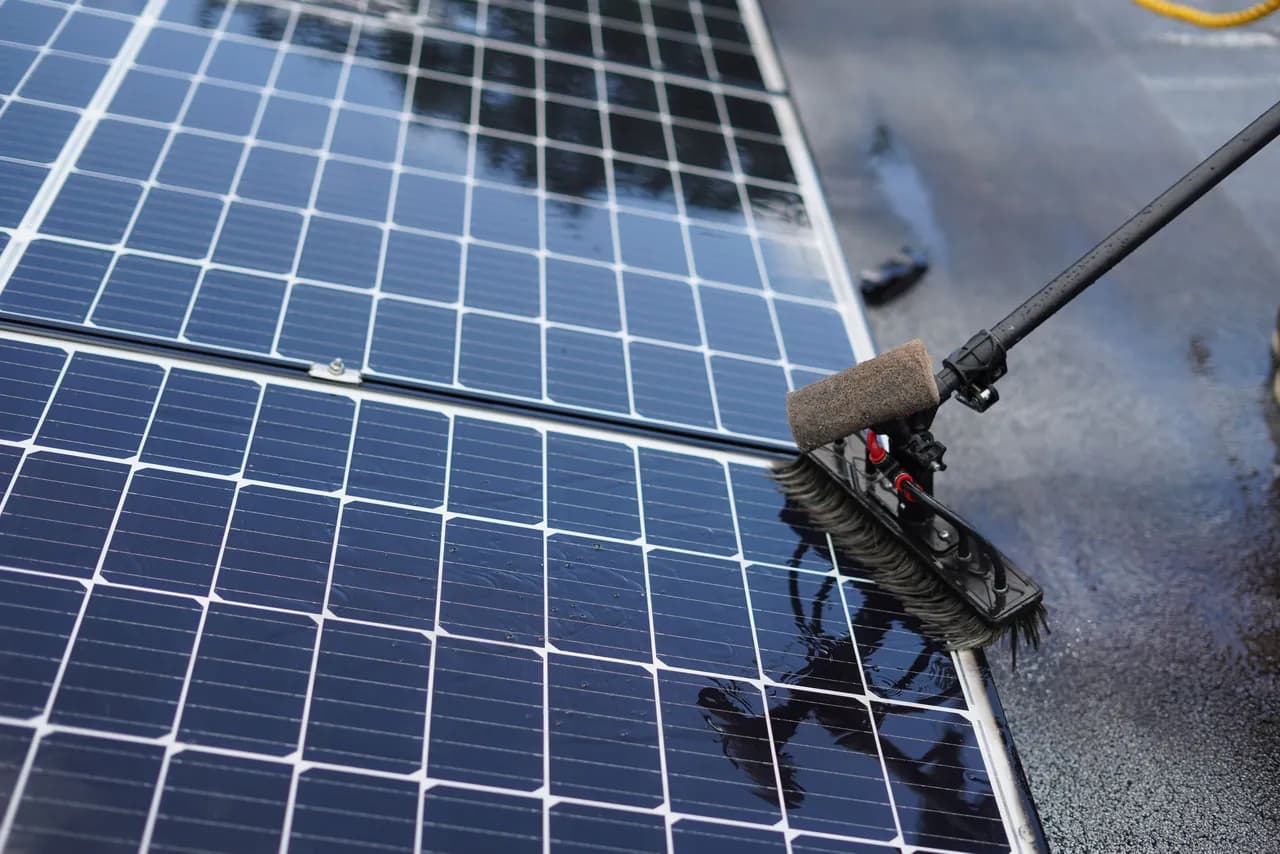
Fine desert dust bonds to glass and does not simply blow off. UAE field studies measured roughly 3% power loss after ten days, 7% after thirty and 13% after ninety with no major sandstorm; GCC reviews report monthly losses reaching around 10%. Low-tilt arrays — the norm on flat commercial roofs — accumulate significantly more than steeper ones, and a single string left dirty drags its whole MPPT input down.
What we specify
Decide the cleaning interval at design stage and price it into the O&M schedule, not after the first disappointing bill. Lay out the array with cleaning access aisles and a safe anchor line, bring treated water to the roof, and where the site justifies it evaluate semi-automatic or robotic cleaning against a manual crew on a cost-per-kWh-recovered basis. Monitoring must report per-string performance so soiling is visible as a divergence between strings rather than as a vague annual shortfall.
Humidity and salt: the coastal corrosion case
The condition
Along the Gulf coast, night-time relative humidity regularly climbs above 90% while daytime surfaces are baking, so metal and connectors go through a daily condensation cycle carrying airborne chloride. That combination attacks unprotected steel, eats cheap clamps, corrodes terminal blocks and is the usual root cause of connector burn-outs found later by thermography.
What we specify
Classify the site under ISO 12944 — C4 to C5 near the coast — and specify the coating system, galvanising grade and fastener alloy against that class rather than against a catalogue default. Use aluminium rails with A4/316 stainless fixings, avoid galvanic pairs, and treat DC connectors as a single-brand rule: mating a connector to a different manufacturer's counterpart is the classic Gulf field failure even when both are rated IP68. Crimp with the manufacturer's tool, torque to spec, and record it.
Sandstorms and wind loading on the mounting system
The condition
The mounting system, not the module, is what fails in a shamal. Wind uplift at roof edges and corners is far higher than in the field of the roof, ballast-only systems can walk or lift on a smooth membrane, and airborne sand abrades glass, anodising and cable sheathing over years. Clamping a module outside the zones the manufacturer's installation manual allows voids the module warranty — quietly, and only discovered when a claim is made.
What we specify
Calculate wind load properly for the site's exposure and building height, and let that calculation — not a supplier's standard layout — set ballast mass, anchor pattern, edge setbacks and tilt angle. Use a mounting system with published wind-tunnel or structural certification, keep module clamp positions inside the manufacturer's permitted zones and record them, break long rail runs with expansion joints, and add a post-sandstorm inspection to the O&M schedule.
UV, cable selection and cable management
The condition
UV and heat destroy ordinary cable and ordinary cable ties. A general-purpose PVC cable run in the open on a UAE roof will craze and crack within a few seasons, and a standard nylon tie becomes brittle and snaps, dropping DC cable onto a hot membrane where it abrades, shorts or arcs. This is one of the most common causes of DC ground faults on badly built Gulf rooftops.
What we specify
Use purpose-made double-insulated solar DC cable to EN 50618 / IEC 62930 (H1Z2Z2-K), rated for 120 °C conductor temperature and UV and ozone exposure, sized so voltage drop stays low at hot-day current. Route cable in UV-stable trays or conduit with support at short intervals, never tie-wrapped to a rail with hardware-store ties, keep it off the roof surface and out of standing water, and use stainless or UV-rated fixings. Label every string at both ends — it is what turns a fault-finding morning into a ten-minute job.
Roof surface temperature and waterproofing on an existing warehouse
The condition
A membrane or metal-sheet roof in a UAE summer reaches surface temperatures well above ambient, so every fixing, pad and sealant on it lives in a daily thermal expansion cycle. Drilled penetrations into an existing warehouse roof are where leaks start, and they may also void the roof sheet or membrane warranty — a point a landlord will raise at exactly the wrong moment. Long aluminium rails expand measurably over a 40 °C swing, and a rail run fixed rigidly at both ends will tear at its anchors.
What we specify
Survey the roof before the array: build-up, remaining service life, existing leaks and the owner's warranty position. Prefer non-penetrative solutions — ballasted frames on membrane, seam clamps on standing-seam sheet — and where penetration is unavoidable use proper flashed and sealed details with EPDM isolation pads rather than mastic over a drilled hole. Design expansion joints into long rail runs, keep walkways off the membrane, and agree in writing who owns the roof warranty after the works.
How a project runs
From the first bill you send us to the monitoring login you keep. Utility approval timelines are set by the utility, not by us, and we say so at the point where it matters.
- 01
Enquiry, bills and load profile
We start from twelve months of utility bills, your connected load, the tariff slab you sit in and — where a meter or BMS can give it — an hourly consumption profile. Solar only pays where generation lands on top of real daytime demand, so this step decides whether the project is worth doing at all before anyone talks about modules.
You receive: A load and consumption analysis with an indicative system size band and an indicative offset of your annual bill.
- 02
Site survey and shading study
A survey team measures the usable roof or ground area, records the roof build-up and its condition, locates the main distribution board and the cable route, and captures the shading horizon — parapets, chillers, stair cores, neighbouring towers. Near-field shading in a dense industrial area removes more energy from a Gulf array than most owners expect.
You receive: A survey report: roof plan with usable area, shading analysis, electrical tie-in point, access and crane notes, and any structural observations to be checked by an engineer.
- 03
Design and yield simulation by a licensed consultant
CoHub engages a licensed, utility-enrolled solar consultant to produce the design: array layout, string configuration, DC:AC ratio, protection and earthing to IEC 62548, and an energy yield simulation using local irradiance data with explicit temperature, soiling and mismatch losses. The stamp on that design belongs to the consultant — which is what the utility will accept and what your insurer and lender will want to see.
You receive: A stamped design package: single-line diagram, layout drawings, string plan, protection and earthing design, and a yield simulation report stating P50 production and the loss assumptions behind it.
- 04
Commercial proposal and bill of materials
The design becomes a priced, itemised bill of materials: every module, inverter, optimiser, cable, connector, rail, clamp, combiner and protective device named by brand, model and datasheet — not a lump sum labelled "solar system". Where a line can be sourced from more than one continent we say so, with the trade-off in lead time, warranty terms and price.
You receive: An itemised bill of materials with datasheets, a scope-of-works schedule, a delivery programme, and a proforma invoice you can take to finance.
- 05
Supply and logistics into the UAE
CoHub buys, consolidates and imports. Modules are ordered against production slots, freight is booked, customs entry is filed, and equipment conformity is evidenced under the MoIAT conformity schemes so that nothing is stopped at the border or rejected at design review. Delivery is staged to the installation programme rather than dumped on a live site.
You receive: Shipping and customs file: packing list, commercial invoice, certificate of origin, conformity documents, serial-number list, and delivery notes signed at your site.
- 06
Installation, testing and commissioning by the licensed contractor
A licensed, utility-enrolled contracting partner mobilises under CoHub's project management: mounting, module installation to the manufacturer's clamping zones, DC and AC works, protection settings, and commissioning tests to IEC 62446-1 — insulation resistance, polarity, open-circuit voltage, string current and I-V curves. CoHub holds the programme, the interfaces and the snag list; the contractor holds the licence and the tools.
You receive: IEC 62446-1 commissioning test records, as-built drawings, equipment manuals, torque and clamping records, and a signed snag-free handover certificate.
- 07
Utility approval, energisation, monitoring and O&M
The enrolled consultant and contractor carry the application through the utility's stages — no objection, design approval, inspection, meter change and energisation — under DEWA's Shams Dubai programme in Dubai, or the equivalent route in Abu Dhabi, Sharjah and the Northern Emirates. After energisation the monitoring portal is handed over and the operations and maintenance schedule starts: cleaning cycles, thermal inspection, torque checks and performance reporting.
You receive: Utility connection approval and net-metering activation, monitoring portal credentials, the warranty pack, and a signed O&M schedule with response times.
Equipment from three continents
Chinese scale, European engineering and American storage and power electronics. We are not tied to one agency line, so the bill of materials is specified against your site and your financing — not against whatever we happen to hold.
21 brands
JinkoSolar
CN · since 2006
N-type TOPCon at utility scale, with the volume to hold a schedule
LONGi
CN · since 2000
Back-contact cells: the highest efficiency per square metre of roof
Trina Solar
CN · since 1997
Modules, trackers and storage from one balance sheet
JA Solar
CN · since 2005
TOPCon built for hot, dusty sites — and shipping into Abu Dhabi now
Sungrow
CN · since 1997
The inverter and battery house behind much of Gulf utility solar
Huawei FusionSolar
CN · since 1987
Telecoms-grade string inverters and grid-forming storage
GoodWe
CN · since 2010
Hybrid inverters and matched batteries, backed from Dubai
BYD Energy Storage
CN · since 1995
A cell manufacturer that builds its own batteries, not an assembler
SMA Solar Technology
DE · since 1981
German inverters with a Dubai service line behind them since 2012
Fronius
AT · since 1945
Actively cooled inverters designed to hold rated power in real heat
Victron Energy
NL · since 1975
Off-grid and hybrid power for sites the utility has not reached
K2 Systems
DE · since 2004
Mounting systems with the structural calculation in the box
Stäubli
CH · since 1892
The MC4 connector — and the certification that mixing brands voids
Schneider Electric
FR · since 1836
Everything between the inverter and the utility connection
Hitachi Energy
CH · since 2020
The grid side: transformers, MV stations and the utility connection
Tesla Energy
US · since 2003
Grid-scale storage with the trading software written around it
Enphase Energy
US · since 2006
Module-level conversion — no high-voltage DC anywhere on the roof
First Solar
US · since 1999
Thin-film cadmium telluride — the desert module, not the silicon one
Generac
US · since 1959
Standby generation for the hours solar and storage cannot cover
Array Technologies
US · since 1989
Single-axis trackers engineered for wind stow and low maintenance
Ampt
US · since 2007
DC optimisers that cut copper, not just harvest a few extra watts
Manufacturer names are used to describe equipment CoHub supplies on UAE projects. CoHub does not claim to be an authorised distributor or agent of any manufacturer listed here.
Standards, approvals and compliance
Equipment certification, grid rules and site approvals — three separate gates, each with a different owner. A quotation that ignores any one of them is not a quotation you can build from.
Module design qualification and safety
IEC 61215 is the design qualification and type approval of terrestrial PV modules — thermal cycling, damp heat, humidity freeze, mechanical load, hail. IEC 61730-1/-2 covers module safety qualification: construction requirements and the test regime behind them. A module without both, current and in the manufacturer's own name, does not belong in a UAE commercial bill of materials.
Safety of inverters and power conversion equipment
Part 1 sets the general safety requirements for power converters in PV systems; Part 2 adds the particular requirements for inverters, including anti-islanding behaviour and residual-current monitoring. The DC-side safety design of the array under IEC 62548 explicitly depends on the inverter complying with this pair, so the two are specified together or not at all.
Array design requirements, and the tests that prove them
IEC 62548 (now IEC 62548-1:2023) governs the DC side: array wiring, over-current protection, switching, earthing and the extra requirements where an array connects directly to batteries. IEC 62446-1 then defines what must be handed to the customer after installation — the commissioning tests, the inspection criteria and the documentation set. Together they are the difference between a system that works and a system you can prove works.
Assemblies and enclosure ratings for outdoor Gulf service
Combiner boxes and distribution boards are assemblies under IEC 61439 — a verified design, not a box someone populated on site. Outdoor enclosures are then rated by IP (IEC 60529) for dust and water ingress and by IK (IEC 62262) for impact; UAE rooftop practice typically calls for IP65 or IP66 with a UV-stable body and a sun shield, because an IP rating says nothing about what 75 °C of direct sun does to a cheap polycarbonate lid.
Corrosion protection for coastal and industrial sites
ISO 12944 classifies atmospheric corrosivity and sets the paint system that answers it. A UAE coastal or near-coastal industrial roof sits in the high categories — C4 to C5 (the 2017 revision replaced the older C5-M / C5-I split with C5, and added CX for offshore and extreme exposure). Specify the category on the drawing, then hot-dip galvanising to ISO 1461, mill-finish or anodised aluminium rails and A4/316 stainless fixings — never a C3 coating quietly substituted to save a few dirhams per metre.
Dubai: connection and net metering
Shams Dubai is DEWA's Distributed Renewable Resources Generation programme. Connection runs in stages — no objection certificate, design approval, inspection and meter installation, then generation — and DEWA accepts applications only from companies enrolled on its solar PV consultant and contractor lists. Ground-mounted arrays were removed from eligibility in 2020, leaving rooftop, façade and building-integrated systems, and system size is bounded by the connected load. CoHub delivers Dubai projects through enrolled partners for exactly this reason.
Abu Dhabi and Al Ain: distribution company approval
Abu Dhabi Distribution Company serves Abu Dhabi and Al Ain Distribution Company serves the eastern region, both under the Abu Dhabi Department of Energy. A distributed system needs the competent authority's prior approval, a connection agreement with the distribution company, and contractors, consultants and PV integrators drawn from the distribution company's own approved lists. Exported surplus is credited as kWh against future bills rather than paid out in cash.
Northern Emirates, Sharjah and the federal framework
Federal Decree-Law No. (17) of 2022 regulates the connection of distributed renewable generation units to the distribution network across the country, including free zones, with prior utility approval still mandatory before energisation. Etihad Water and Electricity (EtihadWE, formerly FEWA) runs the Distributed Solar System programme for Ajman, Umm Al Quwain, Fujairah and Ras Al Khaimah with its own certified contractors, while Sharjah is served by the Sharjah Electricity, Water and Gas Authority (SEWA). Requirements differ by emirate, so we confirm the current rule with the utility before the design is fixed — never after.
Civil Defence approval for battery energy storage
Battery rooms and containerised storage are a Civil Defence matter, governed by the UAE Fire and Life Safety Code of Practice. Expect the design to be assessed on room separation and fire rating, detection and suppression suited to lithium chemistry, ventilation and thermal-runaway gas management, spacing and access for firefighting, and emergency shutdown. A valid Civil Defence approval is also what your insurer will ask for, so storage is designed to it from day one rather than retrofitted to it later.
Conformity of imported equipment
Product conformity in the UAE sits with the Ministry of Industry and Advanced Technology, which absorbed ESMA in 2020. The Emirates Conformity Assessment Scheme (ECAS) is the point-in-time certificate of conformity that lets regulated equipment be imported and sold; the Emirates Quality Mark (EQM) is the higher tier adding factory assessment and ongoing surveillance. As importer of record, CoHub is the party that has to hold those documents — and hand them to you, because a design reviewer can ask for them.
Roof loading and the building permit
An array adds dead load, wind uplift and point loads to a roof that was designed without it. The relevant municipality and the building owner will want a structural assessment of the existing roof and, depending on the emirate and the scope, a building or modification approval before work starts. On a leased warehouse there is a second question nobody asks early enough: what the roof-sheet manufacturer's own warranty says about penetrations.
Terms in your quotation
The twelve terms a solar proposal will put in front of your finance team, in plain language.
- kWp vs kWh
- kWp (kilowatt-peak) is the size of the system — the power its modules produce under standard test conditions. kWh (kilowatt-hour) is the energy it actually delivers over time, which is what your bill is made of. A 500 kWp array never produces 500 kW in a UAE summer noon, and comparing two proposals on kWp alone tells you nothing about the kWh either one will generate.
- DC:AC ratio
- The ratio of installed module power (DC) to inverter rated power (AC). Ratios above 1.0 are normal and intentional: the array rarely reaches its rated output, so a slightly undersized inverter runs at high efficiency for more hours. Push it too far and the inverter clips the peak on the best days. In the UAE, heat losses make a higher ratio easier to justify than in a temperate climate — but it must be modelled, not assumed.
- Performance ratio (PR)
- The share of theoretically available energy that the system actually delivers, after temperature, soiling, wiring, mismatch, inverter and availability losses. It is the single cleanest number for judging build quality, because it is independent of how sunny the site is. A Gulf rooftop with a disciplined cleaning regime and good thermal design sits meaningfully higher than one without; ask any bidder what PR their simulation assumes and what soiling loss is inside it.
- Specific yield
- Annual energy per unit of installed capacity, written as kWh/kWp/year. It is how you compare a 200 kWp roof in Jebel Ali with a 2 MWp roof in Al Ain on equal terms. A well-oriented, regularly cleaned UAE array indicatively falls in the 1,600–1,900 kWh/kWp/year band, but the number that matters is the one your own simulation produces for your own roof.
- Net metering
- A billing arrangement in which a bi-directional meter records both the energy you import from the grid and the surplus you export, and your bill nets one against the other. In the UAE the surplus is credited in kWh and carried forward against future consumption rather than paid out in cash, which is why sizing follows your daytime load rather than your available roof area.
- Bifacial gain
- The extra energy a double-sided module harvests from light reflected off the surface beneath it. The gain depends almost entirely on albedo and mounting height: a white membrane, light gravel or desert sand with the array raised clear of the surface can add meaningfully, while a dark roof with modules mounted close to it adds close to nothing. Treat any bifacial gain quoted without a stated albedo and mounting height as marketing.
- PID (potential-induced degradation)
- A gradual loss of module power caused by leakage current driven by the voltage difference between cells and the earthed frame, accelerated by heat and humidity — precisely the UAE coastal combination. It shows up as strings that quietly underperform their neighbours. Modern PID-resistant cell and encapsulant designs and correct system earthing largely address it; it is a question worth putting to a module supplier directly.
- MPPT (maximum power point tracking)
- The inverter function that continuously adjusts operating voltage to keep each string at its most productive point as irradiance and temperature change. The practical consequence is design discipline: strings on one MPPT input should share orientation, tilt and shading, because the tracker settles on a compromise for all of them. More independent MPPT inputs means more tolerance for a roof with several faces or awkward obstructions.
- String vs central inverter
- String inverters are smaller units distributed across the array; a central inverter is one large machine serving the whole plant. Strings give redundancy — one failure takes out a fraction of the system — more MPPT inputs for a complex roof, and a spare you can swap yourself. A central inverter is usually cheaper per kW and easier to maintain in one place at utility scale, but a fault stops everything. On UAE rooftops the trade-off is normally decided by roof geometry and by how much downtime the site can absorb.
- BESS and depth of discharge (DoD)
- A BESS is a battery energy storage system: cells, a battery management system, a power conversion system and its thermal and fire-safety arrangements. Depth of discharge is how much of its nominal capacity you are allowed to use per cycle, so a 100 kWh battery at 90% DoD gives 90 kWh usable — and cycle life is quoted against a specific DoD, which is why two batteries with the same headline kWh can be very different assets.
- LCOE (levelised cost of energy)
- The total lifetime cost of the system — capital, financing, O&M, cleaning, inverter replacement — divided by the total energy it produces over its life, expressed in fils or AED per kWh. It is the only number that lets you compare a solar project against your current tariff on equal terms, and it is where cheap equipment usually loses: a lower purchase price with higher degradation and a shorter inverter life produces a worse LCOE.
- O&M (operations and maintenance)
- The scheduled service contract that keeps the plant producing what the simulation promised: cleaning cycles, thermographic and visual inspection, torque and earthing checks, inverter servicing, string testing, spare-part holding and performance reporting. It is quoted per kWp per year against a defined scope and response time. In the Gulf it is not an optional extra — without a cleaning regime, soiling alone takes a double-digit percentage of your annual yield.
Questions buyers actually ask
Who holds the licence for the installation work — you, or someone else?
CoHub holds a UAE General Trading licence. We supply the equipment and we are your single commercial counterparty for the project: one contract, one invoice, one party accountable for scope, schedule, delivery and warranty. The design, the installation, the testing and the utility approval are carried out by licensed, utility-enrolled consultants and contractors that we engage and manage on your behalf — in Dubai that means companies enrolled with DEWA under Shams Dubai, and the equivalent approved lists in Abu Dhabi, Sharjah and the Northern Emirates. That structure is deliberate rather than a workaround: the utility will only accept an application from an enrolled company, so you get a specialist's stamp on the design and a specialist's crew on the roof, while dealing commercially with one supplier instead of chasing four. What CoHub does not do, and will not claim, is sign as the licensed contractor or the licensed consultant itself.
How does net metering actually work under DEWA's Shams Dubai?
Your array feeds the building first. Whatever you do not consume at that moment is exported to DEWA's network and recorded by a bi-directional meter, and your bill nets imported kWh against exported kWh. If you export more than you import in a billing period the bill goes to zero and the surplus carries forward as a kWh credit to the next period. Two things follow from that, and they drive the entire sizing decision: there is no feed-in tariff and no cash payment for surplus — the credits only offset future consumption — and a system sized well beyond your daytime load simply banks credits you may never use. That is why we start from your load profile and generally size to daytime self-consumption rather than to available roof area.
What are realistic lead times from signature to energisation?
We give you a programme, not a slogan, and it is built from four independent clocks: equipment manufacturing and shipping, which depends on whether the modules and inverters are stocked in the UAE or ordered against a factory slot; the licensed consultant's design and the utility's review; installation, which scales with system size and roof access; and the utility's inspection, meter change and energisation, which is outside anyone's control. Rooftop commercial projects typically move in months rather than weeks, and the utility approval stages are usually the longest single item. Your proposal carries a dated programme with the float shown, and we tell you at the time which line is the critical one.
What happens when something fails under warranty, three years from now?
You raise it with CoHub, and CoHub runs the claim. Manufacturer warranties on solar equipment are long — module performance warranties are typically 25 to 30 years with a separate product warranty of about 12 to 15 years, and inverters usually 5 to 12 years with extensions available at purchase — but a warranty is only worth the process behind it, and a Gulf RMA is a logistics problem as much as a legal one. Before we quote, we confirm how each brand handles claims in this region: whether there is a regional service centre, whether a replacement is shipped in advance, who pays freight and labour, and what the turnaround is. We keep your serial-number list, your commissioning records and your purchase documents so a claim opens with evidence rather than with an argument. Exact terms are the manufacturer's and vary by brand and by SKU — we put the actual warranty documents in your handover pack rather than summarising them.
Does output drop in summer, when we need it most?
Per kWp installed, yes — and the honest version is worth understanding. Summer brings the longest days and the most irradiance, so monthly energy is high, but instantaneous efficiency falls: heat costs roughly 0.29 to 0.35% of peak power per degree of cell temperature above 25 °C, dust accumulates faster, and humidity and haze scatter light. The result is that a summer noon does not give you the nameplate kW you saw on the datasheet. The commercial point, though, is that your air-conditioning load peaks in the same hours, so a UAE building typically self-consumes a very high share of summer generation. We model this month by month in the yield simulation rather than quoting a single annual figure, so you can see the summer curve against your own consumption curve.
Is a battery worth it for us?
Often not, and we will say so. Under a net-metering arrangement where surplus already carries forward as a kWh credit, a battery is buying you something the meter gives you for free, and it adds capital cost, a Civil Defence approval, a thermally managed room and an asset with its own cycle life. Storage earns its place for specific reasons: genuine backup for a process that cannot be interrupted, a site with weak or no grid connection, significant night-time load that solar cannot reach, or a tariff structure where shifting energy has real value. We size storage against your outage tolerance and your night-time load, we state the usable capacity after depth-of-discharge limits rather than the headline kWh, and if the numbers do not justify it we tell you that instead of selling it.
What does maintenance actually cost and involve?
A PV system has almost no moving parts, so maintenance in the Gulf is dominated by cleaning, inspection and the eventual inverter replacement. A typical O&M scope covers a defined cleaning cycle, annual thermographic inspection of modules, connectors and boards, torque and earth-continuity checks, inverter filter and fan servicing, string I-V verification, and a performance report that compares actual output against the simulated yield. Cost is quoted per kWp per year against a defined scope and response time, because a number without a cleaning frequency attached is meaningless — cleaning frequency is the single biggest driver on a UAE site. We price O&M as a separate, transparent line in the proposal so you can compare it against another bidder's line rather than against a bundled total.
Why is there no price list for solar on this site?
Because a per-watt price quoted before a survey is a guess, and usually a low one that grows later. What actually sets the cost of your system is the roof structure and whether it needs strengthening, the mounting method the roof allows, the distance and route from array to the main distribution board, the shading, the utility's requirements in your emirate, the brands specified and where they ship from, and the scope of O&M you want. We survey, we design, and then we quote against an itemised bill of materials where you can see every line. If you want a rough order of magnitude before committing to a survey we will give you one verbally and label it as an estimate — we will not print it on a page as if it were a price.
How do payment and invoicing work?
The same way as the rest of CoHub, with the documents a UAE finance department expects. You receive a proforma invoice against the approved bill of materials for internal approval and budget release, and the tax invoice is issued in CoHub's name with 5% VAT and our TRN, in the format the Federal Tax Authority requires, with your own TRN recorded on it so the input tax is recoverable on your side. Cash on delivery is available in line with our standard business terms; for a staged project, payment follows agreed milestones — equipment supply, installation, commissioning and handover — set out in the contract before anything is ordered. Nothing ships without a signed proforma, so there are no surprises on either side.
What documents do we end up holding at handover?
A file you can hand to an auditor, an insurer, a lender or the next facilities manager without going back to anyone. It contains the stamped design package and as-built drawings; the IEC 62446-1 commissioning test records; equipment datasheets, manuals and conformity documents; the full serial-number list of modules and inverters; the manufacturers' original warranty certificates with their claim procedures; the utility connection approval and net-metering confirmation; monitoring portal credentials; the O&M schedule with cleaning intervals and response times; and the commercial file — proforma, tax invoice, customs and shipping documents. If a document is not in that pack, the project is not finished.
Read before you buy
Long-form guides from the desk that will quote your project.
Start with your last electricity bill
Send it with the site address and we will come back with a sizing, a bill of materials and a survey date.
Manufacturer names are used to describe equipment CoHub supplies on UAE projects. CoHub does not claim to be an authorised distributor or agent of any manufacturer listed here.