
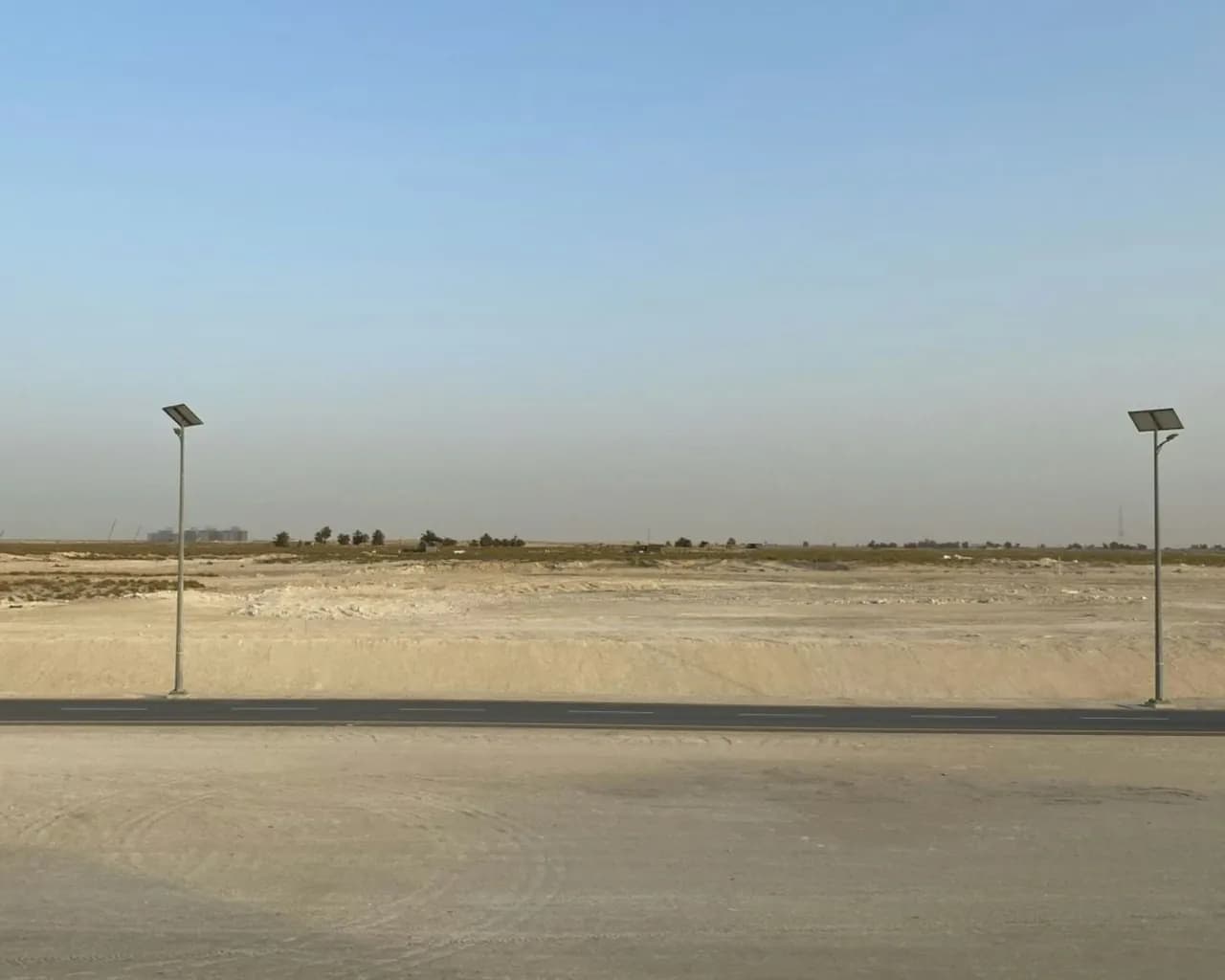
Solar Street & Area Lighting
Light where the trench would have cost more than the pole.
Typical size
From a single pole to several hundred units; typically 30–120 W LED per luminaire (indicative)
Indicative timeline
Indicative: 1–3 weeks for the lighting brief, photometric design and autonomy calculation; 4–10 weeks for supply and installation depending on quantity and foundation work. On public roads, authority approval sits on the critical path and its duration is outside CoHub's control.
All-in-one and split solar lighting for compounds, internal roads, car parks, labour accommodation, parks and perimeters. The commercial case is rarely the electricity: it is avoiding the trenching, cabling, ducting and metered connection that conventional lighting needs. CoHub supplies the luminaires, poles, batteries and controls as a specified package with the photometric layout behind it, handles UAE customs clearance, and delivers installation through licensed partners where a civil or electrical scope is involved.
Who it is for
- Residential and industrial compounds lighting internal roads, footpaths and parking areas
- Labour accommodation, staff villages and remote facilities where safe night lighting is a welfare requirement
- Parks, corniches, walkways and landscaped areas where trenching would damage planting or paving
- Perimeters, yards, laydown areas, farms and construction sites needing light before a supply exists
What the package covers
- Site walk and lighting brief: road or area class, pole spacing, mounting heights and the target illuminance
- Photometric design producing a lux plan with uniformity, so the layout is calculated rather than guessed
- Autonomy and battery sizing for consecutive poor-generation nights, with a stated dimming and motion profile
- Structural check of pole, bracket and foundation for wind loading on the panel and luminaire assembly
- Supply of luminaires, integrated or separate PV, LFP batteries, controllers, poles, brackets and anchor cages
- Freight, marine insurance, UAE customs clearance and phased delivery to match the installation programme
- Foundations, pole erection, alignment and commissioning by licensed contracting partners; authority approval where the road is public
- Night-time acceptance walk, cleaning and maintenance schedule and a spare-parts holding of batteries and drivers
What you end up holding
- Photometric report: lux levels, uniformity ratio, pole spacing and mounting height for each area type
- Autonomy calculation stating the number of no-generation nights covered at the specified dimming profile (indicative)
- Pole and foundation drawing with the wind-load basis and anchor-bolt detail
- Installation and commissioning record including a night-time acceptance walk and per-pole serial register
- Maintenance and cleaning schedule, plus the consolidated warranty pack covering luminaire, battery and controller
Indicative parameters
Typical values for a UAE site. Your figures come from the survey and the yield simulation.
- Luminaire
- LED at roughly 130–170 lm/W, 3000K–5000K by application, with a defined optical distribution (indicative)
- Battery
- LFP rather than lead-acid or NMC, selected for cycle life and high-ambient behaviour in the pole head
- Autonomy
- Typically 3–5 nights at the specified dimming profile (indicative, depends on dust and season)
- Ingress and impact
- IP66 luminaire and battery compartment, IK08 or higher where vandalism or vehicle strike is a risk
- Control
- Dusk-to-dawn with programmable dimming and optional motion boost; remote management on larger schemes
- Corrosion and finish
- Hot-dip galvanised pole with powder coat; C5-M specification near the coast
- Standards
- Luminaires to the IEC 60598 family, cells and battery systems to IEC 62619, with UAE conformity under MoIAT
Typical values for a UAE site. Your figures come from the survey and the yield simulation.
The saving is in the trench, not the tariff
A conventional street light is cheap; getting power to it is not. Cable, ducting, draw pits, road crossings, reinstatement, a feeder pillar and a metered connection frequently cost several times the luminaire itself, and on a landscaped or already-paved site the disruption cost is higher still. A solar pole removes that entire civil and electrical chain, which is why the economics work best exactly where conventional lighting is most awkward: long perimeters, park pathways, farm tracks, compound roads and new phases where the permanent supply has not arrived. It also decouples the lighting from the building supply, so a power cut leaves the site lit. Where a supply already runs past the pole position, conventional lighting is often the better answer, and we will say so.
Lux on the ground, not watts on a label
Solar street lighting is sold badly more often than it is engineered badly. Listings advertise enormous wattage or lumen figures with no optical distribution, no pole height and no spacing, which tells you nothing about whether the road will actually be lit evenly. The specification that matters is a photometric layout: target illuminance for the class of road or area, uniformity ratio so there are no dark gaps between poles, mounting height, arm length and the luminaire's optical distribution. A modest, well-distributed luminaire at the correct spacing outperforms a bright one throwing light onto the neighbouring wall. We produce the lux plan as a deliverable so the design can be checked before anything is ordered, and again at the night-time acceptance walk.
The battery is the part that decides the life
In an all-in-one pole the battery sits in the hottest place on site: a sealed head, in full sun, on a metal pole, in a climate that reaches 50°C. That is why chemistry and placement matter more than any other line on the datasheet. LFP cells tolerate the conditions far better than lead-acid or NMC alternatives, and a design that shades or ventilates the battery compartment will outlive one that does not, regardless of what both quote as rated cycles. The second determinant is the control profile: full output all night through the whole year is the fastest way to deep-cycle a battery flat, whereas a sensible dimming schedule with motion boost on quiet paths delivers the same perceived safety at a fraction of the energy, and pushes autonomy from a marginal one or two nights to a comfortable three to five.
Private roads, public roads and who approves what
Inside a private compound, a farm, a yard or a labour village, solar lighting is generally a straightforward supply and installation exercise with the site owner setting the lighting standard. On a public road, a shared access road or an area under a municipality or roads authority, there are lighting classes, pole specifications, colour temperatures and approval processes to satisfy, and the design must be submitted and approved before installation. The rule is the same as everywhere else in this vertical: CoHub supplies the equipment and manages the delivery, while any submission, certification and electrical or civil execution that requires a licence is carried out by the licensed contracting and consultancy partners appointed on the project. We establish which category your site falls into before the layout is fixed.
Buying quantity without buying regret
Street lighting is bought in hundreds of units, which is exactly why the specification has to be right before the order is placed: a wrong choice is multiplied by the quantity. The parts that fail early in this climate are predictable — the battery, the driver and the seal on the compartment — so the package is specified around serviceability: a battery that can be replaced in the field without changing the whole head, a driver that is a stocked part rather than a proprietary one, and a gasket that is available as a spare. CoHub supplies the units with conformity documentation for UAE market entry under the MoIAT scheme, clears the shipment, and phases delivery so poles arrive as the foundations are ready rather than sitting in a yard for a season.
Equipment we source for this
A shortlist, not a fixed specification. Availability in the UAE, warranty cover in this territory and acceptance by your utility are all confirmed per project before anything is quoted — some of these makes are supported here more fully than others, and each brand page says which.
Manufacturer names are used to describe equipment CoHub supplies on UAE projects. CoHub does not claim to be an authorised distributor or agent of any manufacturer listed here.
Questions on this solution
How many nights will the lights stay on without sun?
Typically three to five nights at the dimming profile we specify, which is an indicative figure that depends on the season, how dusty the panel is and how much motion boost the location triggers. We state the autonomy calculation and the assumed profile in writing, because an autonomy claim without a stated dimming profile is meaningless.
Do solar street lights work in a sandstorm season?
They keep working, but a dust-covered panel charges poorly, and after a significant sandstorm a clean is needed rather than optional. That is why the maintenance schedule is part of the package and why the autonomy is sized with margin instead of to the theoretical minimum. On larger schemes, remote management flags poles that are not charging properly so cleaning can be targeted instead of blanket.
All-in-one or split panel and battery?
All-in-one units install faster, cost less and suit compounds, paths and car parks. Split systems, with a separate tilted panel and a ground or mid-pole battery box, suit higher poles, higher output and hotter or dustier locations, and they let the panel be angled properly and cleaned from the ground. The decision follows pole height, required output and who will maintain them.
Can we use these on a public road?
Only with the relevant authority's approval, and the design must meet its lighting class, pole and finish requirements. That submission is made by the licensed consultant or contractor appointed on the project. Inside a private compound or industrial plot the process is much simpler, and the site owner sets the standard. We confirm which applies before fixing the layout.
Start with your last electricity bill
Send it with the site address and we will come back with a sizing, a bill of materials and a survey date.
Request a quotation