
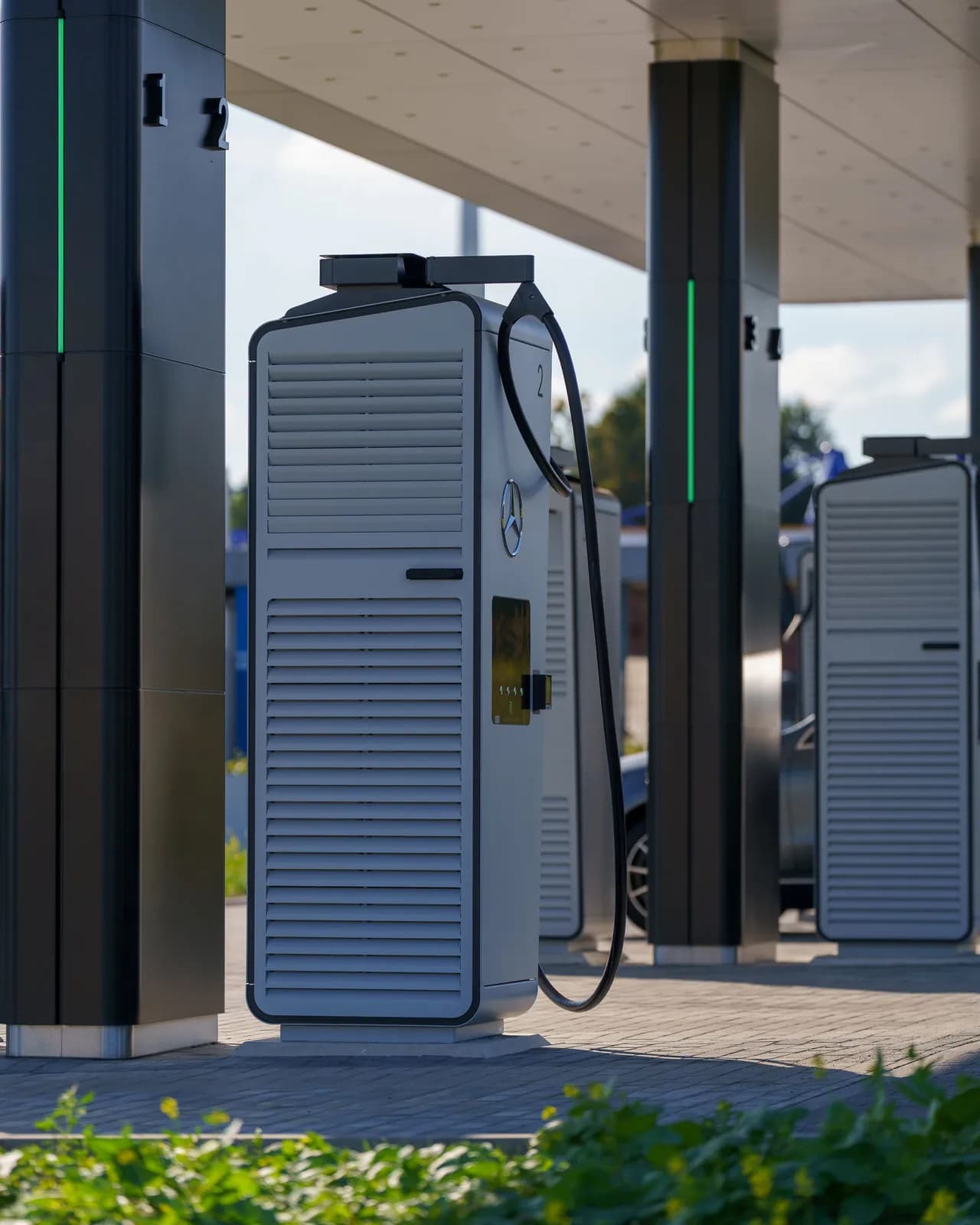
Solar-Backed EV Charging
Charge the fleet on midday sun instead of on a peak-hour supply upgrade.
Typical size
7.4 kW to 22 kW AC per point and 60 kW to 360 kW DC per unit, with solar and storage sized to the duty (indicative)
Indicative timeline
Indicative: 2–4 weeks for the duty and supply study and design; 4–12 weeks for supply, civil works, installation and commissioning depending on charger count and whether DC units and storage are included. Utility notification or approval requirements are confirmed at design stage and their duration is outside CoHub's control.
Charging infrastructure for fleets, staff car parks, facilities and hospitality sites, backed by on-site solar and, where the duty demands it, storage. The engineering problem is rarely the charger; it is the incoming supply, the load management and the civil works. CoHub supplies the chargers, the solar and the electrical package and manages the delivery programme, while design, installation, utility notification and commissioning are performed by licensed, utility-enrolled contracting and consultancy partners.
Who it is for
- Fleet and logistics operators electrifying vans, light trucks or buses with predictable depot dwell times
- Corporate offices, business parks and campuses offering workplace charging to staff and visitors
- Retail centres, hotels and leisure destinations where charging is an amenity and a dwell-time driver
- Facilities managers planning phased charger rollout across a portfolio of buildings and car parks
What the package covers
- Duty study: vehicle count, battery sizes, dwell windows, daily kilometres and the realistic simultaneous-charging factor
- Supply assessment: existing incoming capacity, spare headroom and whether load management avoids a supply upgrade
- Solar and storage sizing against the charging profile, so midday generation carries as much of the duty as possible
- Electrical design, protection, earthing and load-management strategy issued by a licensed consultant on the project
- Supply of AC and DC chargers, distribution boards, protection, metering, containment, PV and storage equipment
- Freight, marine insurance, UAE customs clearance and delivery sequenced to the civil and electrical programme
- Civil works, installation, protective bollards, cabling and commissioning by licensed contracting partners
- Utility notification or approval where required, back-office and OCPP integration, driver access setup and O&M cover
What you end up holding
- Duty and capacity study: charger count and rating, simultaneity assumption and whether a supply upgrade is avoided
- As-built single-line diagram, load-management scheme, protection schedule and earthing arrangement
- Solar and storage yield report showing the modelled share of charging energy met on site (indicative)
- Commissioning and test certificates for each charge point, including RCD, earth-loop and charge-session tests
- Utility correspondence and approval file where the connection or export arrangement required it
- Back-office handover, access and tariff configuration, O&M scope and the consolidated warranty pack
Indicative parameters
Typical values for a UAE site. Your figures come from the survey and the yield simulation.
- AC charging
- 7.4 kW single-phase or 11–22 kW three-phase, Type 2, suited to dwell times over two hours (typical)
- DC charging
- 60–360 kW CCS2, for fleet turnaround and public-facing points; power-sharing cabinets where dwell varies
- Interoperability
- OCPP 1.6J as a minimum, OCPP 2.0.1 preferred, so the back office is not locked to one manufacturer
- Load management
- Dynamic load balancing across points against the site maximum demand, commonly avoiding a supply upgrade
- Environmental rating
- IP65 or higher with IK10 impact rating outdoors; shaded siting and derating checked at 50°C ambient
- Standards and conformity
- IEC 61851 charging equipment and IEC 62196 connectors, with UAE market conformity under the MoIAT scheme
- Solar coupling
- Carport or rooftop PV with optional storage to buffer DC-charging peaks the supply cannot absorb
Typical values for a UAE site. Your figures come from the survey and the yield simulation.
The charger is the cheap part
Most EV charging projects are costed backwards. The unit price of a charge point is easy to find, while the real expenditure sits in the incoming supply, the distribution board, the trenching and containment across a car park, the protective bollards and the commissioning. A site with ten vans returning at 18:00 and plugging in simultaneously can present a very large coincident load, and an unmanaged design answers that with a supply upgrade that may cost more than the entire charger order. A managed design answers it by spreading the energy across the dwell window, because the vehicles are parked for twelve hours and need charge, not speed. The first deliverable is therefore a duty study, not a quotation: how many vehicles, how much energy each, and how long they actually stand still.
Why solar and charging belong together
Workplace and destination charging happen mostly in daylight, which makes them an unusually good match for on-site generation: the energy is produced a few metres from where it is consumed, with no network losses and no reliance on how generously the local net-metering scheme treats exported surplus. A carport does the job twice over, shading the vehicles and generating above them. Where the pattern is a depot that charges at night, solar still helps by offsetting the daytime building load, and a battery can be used to move midday generation into the evening charging window or simply to shave the peak that fast charging creates. The sizing exercise puts these three elements — array, storage and charger power — into one model rather than buying them as separate projects.
Fifty degrees is a charger specification
An outdoor charger in the UAE lives in conditions most product datasheets were not written for. Ambient above 50°C means thermal derating is a real operational question: a unit that delivers its headline power in a European summer may step down in a Dubai August, and that behaviour belongs in the duty study rather than in a complaint six months after handover. Shaded siting, whether under a solar canopy or a purpose-built structure, both improves the charger's thermal margin and the customer's experience. Mechanical protection matters too: outdoor units need IP65 or better with a high impact rating, bollards where reversing vehicles can reach them, and cable management that keeps a heavy DC lead off the ground and out of the path of tyres.
Open protocols, so the asset stays yours
The most expensive mistake after under-sizing the supply is buying chargers locked to a single vendor's back office. OCPP 1.6J is the practical minimum and OCPP 2.0.1 is preferable, because it lets you change management platform, tariff model or operator without replacing hardware. For a fleet, the back office is where the value sits: per-vehicle energy, per-driver access, scheduled charging inside the solar window, and data clean enough to reconcile against your fuel-card history. For a public-facing site, it is the payment, tariff and uptime reporting. We specify the protocol requirement before the hardware, and configure the platform as part of commissioning rather than leaving it as homework for your IT team.
Supply, delivery and the licensed scope
CoHub supplies the chargers, the PV, the storage where it is used, and the whole electrical package, carries the supply contract as your single commercial counterparty, and manages the programme through customs clearance, civil works and commissioning. Electrical design and the load-management strategy are issued by a licensed consultant appointed on the project; installation, testing and any utility notification or approval are carried out by our utility-enrolled contracting partner. Charging equipment is specified to IEC 61851 with IEC 62196 connectors and the conformity documentation required for UAE market entry under the MoIAT scheme. Because charger connection requirements differ between Dubai, Abu Dhabi and the Northern Emirates, the applicable route is confirmed with the relevant utility at design stage rather than assumed.
Equipment we source for this
A shortlist, not a fixed specification. Availability in the UAE, warranty cover in this territory and acceptance by your utility are all confirmed per project before anything is quoted — some of these makes are supported here more fully than others, and each brand page says which.
Manufacturer names are used to describe equipment CoHub supplies on UAE projects. CoHub does not claim to be an authorised distributor or agent of any manufacturer listed here.
Questions on this solution
Will we need to upgrade our electrical supply?
Often not, and that is the main purpose of the capacity study. Dynamic load management spreads charging across the available headroom and the dwell window, which very frequently keeps a fleet or workplace installation inside the existing supply. A supply upgrade becomes genuinely necessary when high-power DC charging has to happen on a short turnaround, and in some of those cases a battery buffer is cheaper than the upgrade.
Can the chargers run purely on solar?
Only in specific cases, and it should not be promised loosely. Daytime workplace charging can be met largely from an array sized for it, but any charging outside the solar window needs the grid or storage. The honest framing is a modelled solar share of charging energy over a year, stated as an indicative figure, and we produce that number from your duty study rather than as a marketing claim.
AC or DC chargers for a delivery fleet?
For vehicles that return to a depot and stand overnight, AC is usually correct and far cheaper: twelve hours at 11 or 22 kW moves a great deal of energy. DC earns its cost where a vehicle must be turned around within the working day, or where a shared charger serves more vehicles than there are bays. Many depots end up with a majority of AC points and one or two DC units for exceptions.
Who obtains the approvals for the chargers?
The licensed consultant and the utility-enrolled contracting partner appointed on the project handle the design submission, any utility notification or approval and the electrical certification. Requirements differ by emirate and by whether the charging is private or public-facing, so we confirm the applicable route with the relevant utility during design. CoHub manages that interface and aligns the equipment supply to whatever the approval requires.
Can we start small and expand later?
Yes, and it is the recommended approach. We size the board, the containment and the cable routes for the eventual charger count you nominate, then install the first phase. Expansion afterwards is a cabling and commissioning exercise rather than civil works, which is by far the largest cost in a retrofit. The extra provisioning at build stage typically costs a small fraction of returning to excavate a finished car park.
Start with your last electricity bill
Send it with the site address and we will come back with a sizing, a bill of materials and a survey date.
Request a quotation